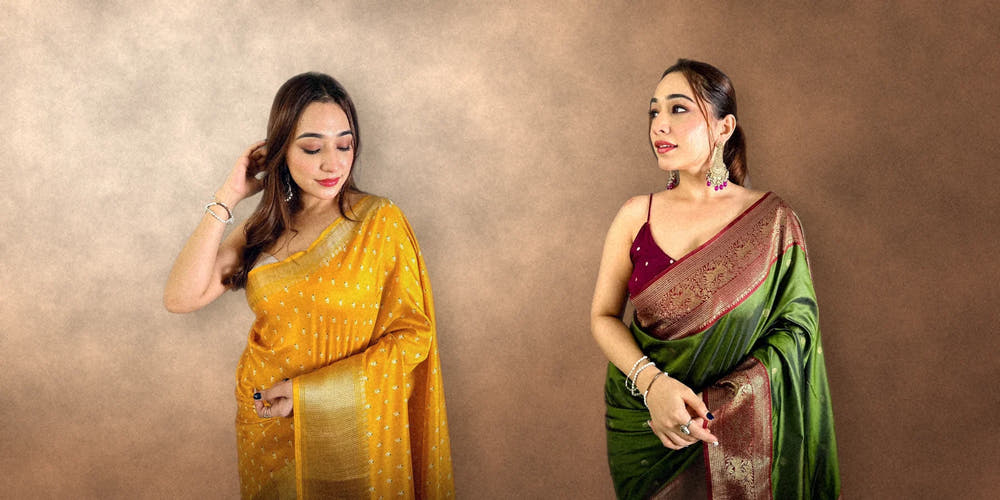
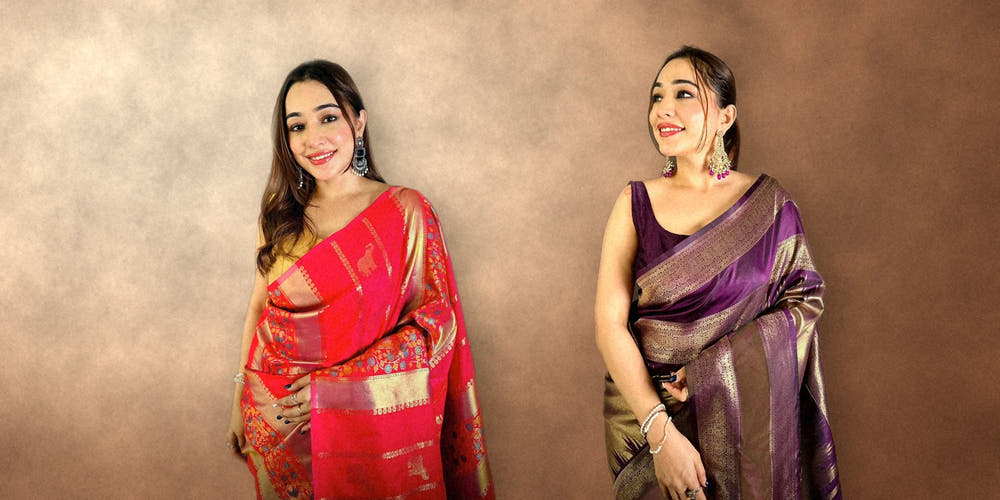
Shop Silk Sarees
 Off White Ethnic Motif Silk Blend Saree
₹ 1,995
 White Soft Silk Pashmina Kashmiri Print Saree
₹ 999
 Pink Bandhej Printed Dola Silk Saree
₹ 750
 Soft Silk Pashmina Kashmiri Print Saree
₹ 999
 Baby Pink Soft Silk Kanjivaram Saree
₹ 1,550
 Sky Blue Pochampally Patola Soft Silk Saree
₹ 1,050
 Cream White Soft Silk Gadwal Checked Saree with Zari Border
₹ 1,250
 Purple Dola Silk Pen Kalamkari Print Saree
₹ 750
Before buying a Banarasi saree in Varanasi, know three things: whether it is handloom or power loom, what the silk and zari really are, and how the seller will stand behind it. Ask to see the back of the weave, feel the weight, and compare a few shops before you decide.
A Banarasi saree is an investment in both money and memory, so a little preparation goes a long way. This guide is written by our stylists to help you walk into any shop with clear questions, whether you are travelling to the city or shopping from home.
What should I know before buying a Banarasi saree in Varanasi?
Start with the idea that Banarasi is a family of weaves, not one saree. The name covers heavy brocades, lighter silks, sheer organza-style weaves and more. Each looks, drapes and costs differently, so decide first what you need the saree for.
Then think about four things: the base fabric, the zari, the way it was woven, and the pallu and border design. A good seller will happily explain all four. If answers are vague or rushed, treat that as a signal to slow down and look elsewhere.
It also helps to decide your budget and occasion before you step in. Shops in any famous textile city are full of beautiful options, and it is easy to be swept toward the heaviest saree on the shelf when a lighter one would suit your wardrobe better.
- Decide the occasion first: wedding, festival, gifting or a keepsake for yourself.
- Choose a rough budget so you can say no politely.
- Ask what the base fabric is and what the zari is made of.
- Ask whether the saree is handloom or power loom.
- Check the pallu, border and blouse piece in daylight.
How do I recognise an original Banarasi saree in Varanasi?
Nobody can judge authenticity from one clue, so look at several together. Start with the weave itself. In a woven Banarasi, the motifs are part of the cloth, not printed or stuck on top. Turn the saree over: you will usually see small floating threads or a neat pattern of thread carried behind the design, rather than a perfectly clean back.
Next, feel the fabric. Silk should feel smooth and have a soft, natural lustre rather than a plastic shine. Heavy brocades will feel substantial, but weight alone is not proof of quality, because a saree can be made heavy with extra zari or filler.
Finally, ask for details in plain words. A seller who knows the saree can tell you whether it is katan silk, a silk blend, organza or georgette, and whether the work is handloom. If you are looking for an original Banarasi saree in Varanasi, the honest answer to those questions matters more than any label.
- Motifs should look woven into the cloth, with a slightly textured back.
- Edges and borders should be even, with no loose or uneven patches.
- The fabric should drape without feeling stiff or crackly, unless it is a deliberately crisp weave.
- Ask for the fibre content in words, not just a brand name.
- Be careful with prices that look too good for the work shown.
Which silk, zari and weave types should I look at?
Knowing a few terms makes shopping far easier. Katan silk is a smooth, tightly twisted silk that gives a fine, rich fall and is a favourite for bridal and festive wear. We have a separate guide to katan silk sarees if you want to read more before you go.
Brocade-style weaves carry dense raised patterns, often with zari in the pallu and body. Tanchoi-style weaves have a finer, subtler pattern and a softer look. Organza and georgette versions are lighter, which many women prefer for daytime events and for warm weather.
Zari deserves a question of its own. Traditional zari is metallic thread, while modern shops also sell lighter, more affordable alternatives that look similar from a distance. Neither is automatically wrong, but you should know which one you are paying for. If the seller cannot say, ask again or move on.
- Katan silk: smooth, fine and rich, good for weddings.
- Brocade: dense, raised motifs, good for statement sarees.
- Tanchoi style: subtle, fine patterning, good for elegant evenings.
- Organza and georgette: lighter and easier to carry for long events.
- Silk blends: more budget friendly and easier to maintain, and they should be described as blends.
How do I choose a Banarasi saree shop or store in Varanasi?
Every traveller wants to find the best Banarasi saree shop in Varanasi, but the best shop is really the one that suits your needs and answers your questions openly. Rather than relying on a single recommendation, visit two or three and compare what you are told.
When you walk into a Banarasi saree shop in Varanasi, notice how the staff behave. A good store lets you handle sarees, unfolds them in daylight, and explains differences without pushing the costliest piece. If you are choosing a Banarasi saree store in Varanasi for a bridal purchase, ask about blouse pieces, fall and pico, and what can be adjusted before you leave.
Ask for a proper bill that describes the saree. Keep the description with the saree afterwards, because it is useful for insurance, for resale and for care decisions. Also ask what happens if you find a defect after reaching home, since some shops do not take returns at all.
- Compare at least two or three places before buying.
- Ask to see the saree in natural light.
- Ask for a written bill that names the fabric.
- Ask about returns and exchanges before paying.
- Do not feel rushed by a guide or an agent.
What can I check at home before travelling to Varanasi?
A little homework saves time. Browse Banarasi designs online so you know which colours, borders and pallus you like. Save pictures on your phone and show them to the seller, which keeps the conversation focused.
If you are not travelling at all, you can still get a good feel for Banarasi-style sarees from home. Our Banarasi Sarees collection is a good place to compare colours and designs, and our Banarasi Sarees Online page keeps the same range easy to browse on your phone. We are based in Surat, and we describe our Banarasi sarees as Banarasi-style unless a product page says otherwise, so you always know what you are buying.
If budget is the main concern, you can start with our Banarasi Sarees Under 2000 collection. For a wedding, our Banarasi Sarees for Wedding collection gathers richer festive looks in one place.
- Save screenshots of designs you love before you shop.
- Note down your blouse colour, fall and pico needs.
- Compare a few pieces side by side at home.
- Keep a budget range handy for any shop you visit.
How should I care for a Banarasi saree after buying it?
Good care keeps zari bright and silk soft for years. Dry clean a heavy Banarasi rather than washing it at home, and avoid perfume or hairspray directly on the fabric. Let the saree air in the shade for a short while after each wear before folding it away.
Fold it in a soft muslin or cotton cloth rather than plastic, and change the fold lines now and then so the zari does not crack along one crease. Keep it away from damp corners and strong sunlight. Our saree storage guide explains how to fold and store each fabric in more detail.
Finally, keep the bill and any care notes the seller gives you. If you ever want to alter the blouse or repair a border, it helps to know exactly what the saree is made of.
- Dry clean heavy silk and brocade sarees.
- Use soft cotton or muslin cloth for storage.
- Refold along different lines every few months.
- Keep away from damp, perfume and direct sun.
Is buying in Varanasi better than buying online?
There is no single answer. Buying in Varanasi lets you touch the fabric and see a huge range in one visit, which many people enjoy as part of the experience. It does take time, travel and some confidence in bargaining.
Buying online suits you if you want to compare calmly, read descriptions and avoid pressure. With Vastranand, orders are packed in 2 to 3 days and take 4 to 5 days on the way, and returns are accepted within 22 days of delivery. Those are the terms to weigh against any shop, so ask every seller for theirs.
Many shoppers do both: they browse online first, learn what they like, and then buy where they feel most comfortable. Whichever route you take, the same questions about fabric, zari, weave and returns will keep you safe.
Read next
- our Banarasi Sarees collection
- Banarasi sarees you can browse online
- Banarasi sarees for a wedding
- Banarasi sarees under 2000
Frequently asked questions
How can I tell if a Banarasi saree is handloom?
Look at the back of the weave. Handloom pieces often show small floating threads and slight, natural variations in the pattern, while printed or machine-made work looks very uniform. Still, check several signs together and ask the seller directly whether the saree is handloom or power loom, and get the answer on the bill.
Is the heaviest Banarasi saree the best one?
Not always. Weight can come from dense zari, extra threads or filler, so it does not prove quality. Judge the silk, the evenness of the weave, the finish of the border and how the saree drapes. A lighter saree can be far more comfortable for a long wedding day.
Should I bargain when buying a Banarasi saree in Varanasi?
Many shoppers do compare and negotiate, but price should follow the fabric and the work. Know what the saree is made of first, then compare two or three shops. A price far below others for the same description is worth questioning rather than celebrating.
Are Vastranand Banarasi sarees woven in Varanasi?
We do not claim that. We are based in Surat, Gujarat, and describe our sarees as Banarasi-style unless a product page says otherwise. Read each product description for the fabric and weave details, and contact us on +91-8154000063 if you want to ask about a particular saree.
What is Vastranand's return period?
Returns are accepted within 22 days of delivery. Orders are packed in 2 to 3 days and take 4 to 5 days on the way. For help with a particular order, you can call +91-8154000063 between Monday and Saturday, 9 am to 9 pm, or write to contact@vastranand.in.
Shop sarees from this story
Off White Ethnic Motif Silk Blend Saree
₹ 1,995
White Soft Silk Pashmina Kashmiri Print Saree
₹ 999
Pink Bandhej Printed Dola Silk Saree
₹ 750
Soft Silk Pashmina Kashmiri Print Saree
₹ 999
Baby Pink Soft Silk Kanjivaram Saree
₹ 1,550
Sky Blue Pochampally Patola Soft Silk Saree
₹ 1,050
Cream White Soft Silk Gadwal Checked Saree with Zari Border
₹ 1,250
Purple Dola Silk Pen Kalamkari Print Saree
₹ 750 Radiant Harmony Katan Silk Saree
₹ 999
 Black and White Check Katan Silk Saree with Gold Zari Border
₹ 999
Watch these sarees in motion
Loved this story? The sarees behind it are waiting for you — handcrafted, factory-direct, delivered across India.
Shop best sellers ← Back to The Vastranand Journal