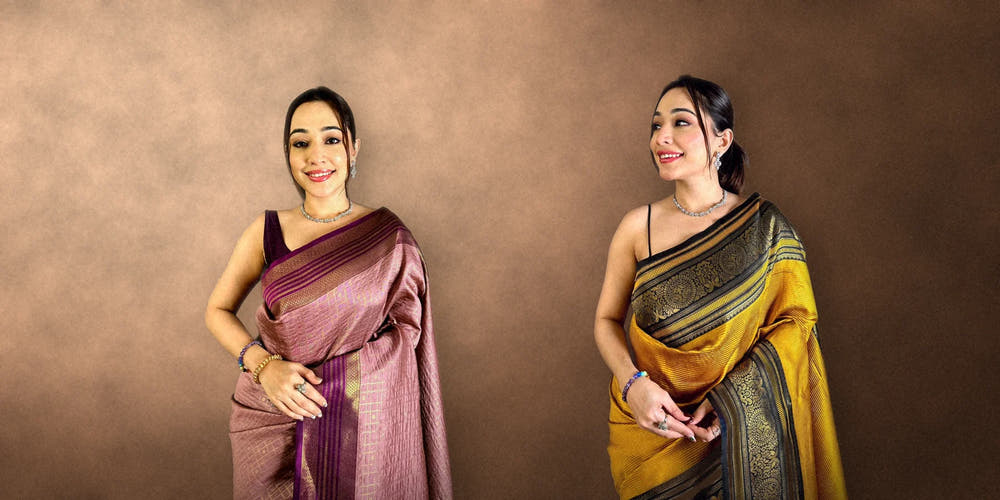
Shop Cotton Sarees
 Peach Cotton Blend Silver Woven Paisley Motif Saree with Tassels
₹ 1,795
 Stylish Pista Colour Woven Design Cotton Saree
₹ 1,795
 Stylish Black Colour Woven Design Cotton Saree
₹ 1,795
 Apricot Orange Cotton Blend Woven Saree with Zari Border
₹ 1,795
 Coral Pink Cotton Woven Motif Saree with Zari Paisley Pallu
₹ 1,795
 Black Cotton Blend Woven Saree with Gold Pallu & Pink Tassels
₹ 1,795
 Light Orange Cotton Blend Woven Saree with Paisley Zari Pallu
₹ 1,795
 Black Cotton Blend Dabu Print Saree with Chevron Border
₹ 1,495
To buy Kalamkari sarees online with confidence, check four things: how the design is made, the fabric, the dyes and finish, and what the seller tells you. Hand-painted, block-printed and digitally printed sarees can look alike in a photo, but they differ up close.
Summer is a good time to shop for Kalamkari, since many of these sarees come in soft cotton and silk cotton that feel light in the heat. This checklist helps you read a product page like a stylist, so you choose the saree you actually want and not just the one that looks closest.
What is the difference between hand-painted, block-printed and digital Kalamkari?
Kalamkari means work done with a pen, and the name points to the original craft. In the hand-painted tradition, an artisan draws and fills the motifs freehand with a kalam, a bamboo pen. Each saree takes time, and no two pieces are exactly the same.
Block-printed Kalamkari uses carved wooden blocks stamped onto cloth, often with hand finishing. It is a genuine craft, only a different one from painting. Digital print is made by a machine from a photograph or file of a Kalamkari design. It copies the look, not the method.
None of these is wrong to buy, as long as you know which one you are getting. The trouble starts when a printed saree is described as hand-painted, or when the page does not say at all.
- Hand-painted: freehand lines, small variations, slower to make.
- Block-printed: repeating motifs stamped with blocks, with slight shifts in alignment.
- Digitally printed: very sharp, even detail and the same pattern repeated exactly.
How to identify an original Kalamkari saree by the motifs and lines
Start with the design itself. Look closely at the outlines of the flowers, peacocks, paisleys, leaves or mythological figures. On a hand-painted saree, the lines wobble a little and the thickness changes as the pen moves. Colours may be filled in slightly off the outline here and there, which is part of the charm.
On a block-printed saree, you will see the same motif repeating with small gaps or overlaps where the block was placed again. On a digital print, repeats are perfectly identical and edges look crisp like a photograph, even in tiny details.
Ask for close-up photos if the listing shows only a full-length shot. A reliable seller will happily share them.
- Zoom in on the outlines and check whether they vary in thickness.
- Compare two repeats of the same motif for tiny differences.
- Look at the pallu and border: are they drawn as part of the design or just placed as a pattern?
- Be careful if every detail looks flawlessly identical.
What should you check in the fabric, dyes and finish?
Traditional Kalamkari is done on cotton or silk, and the cloth is usually prepared before colouring so that the dyes hold. Natural dyes tend to give earthy shades such as madder reds, indigo blues, mustard and deep greens. Very neon or glossy tones are a sign to ask more questions.
Turn to the reverse side of the saree if you can see it in a photo or in person. On painted or block-printed cloth, the colour usually shows through to the back, and the back looks only slightly paler. On many digital prints, the back is clearly lighter, with the design sitting on the surface.
Feel matters as well. A hand-worked cotton saree feels soft and slightly textured, while a printed polyester look-alike may feel slippery. Read the fabric line on the page carefully and look for a plain statement of the material, such as cotton, silk cotton or a blend.
- Check that the fabric is named clearly, and that a blend is called a blend.
- Earthy, slightly muted colours are more typical of natural dyes.
- Compare the front and back of the cloth.
- Expect small irregularities in handwork, not machine-perfect finish.
What should a seller tell you before you buy Kalamkari sarees online?
The product page is your best evidence. A trustworthy listing explains the technique in plain words: hand-painted, block-printed or digitally printed. It names the fabric, shows the saree in daylight, and includes close-ups of the pallu, border and body.
Be cautious with vague phrases such as Kalamkari style or Kalamkari inspired when the page never says how the design was made. Such words can be perfectly honest, but they should come with an explanation. If you are not sure, write to the seller and ask directly.
Return terms matter too, because colour on a screen can differ slightly from colour in your hands. Clear return rules give you room to check the saree yourself.
- Is the technique stated in the description?
- Is the fabric named, with any blend declared?
- Are there close-up photos and daylight photos?
- Are the return and delivery terms easy to find?
- Is there a phone number or email for questions?
What is the best place to buy Kalamkari sarees online in India?
There is no single answer, because the best place is the one that is open about what it sells. Look for a seller that names the craft and the method, shows real close-ups, and answers questions without hurry. Compare two or three sellers on those points before you decide on a saree.
At Vastranand, we pack orders in 2-3 days and they are on the way for 4-5 days after that. Returns are accepted within 22 days of delivery, which gives you time to check the fabric, the colour and the finish at home. You can reach our team on +91-8154000063, Monday to Saturday, 9 am to 9 pm, or write to contact@vastranand.in if you want to ask about a saree first.
To see how craft is explained, read our Craft Stories collection. It is a good way to learn how handwork differs from machine work, whichever saree you end up choosing.
Which Kalamkari saree suits summer, and how do you care for it?
For hot weather, cotton and silk cotton are comfortable choices, because they are lighter than heavy silks and feel soft against the skin. Kalamkari motifs on a plain or lightly bordered body also look polished for the office, a daytime puja or a family lunch.
If you like handwoven bases, browse our handloom sarees, or look at silk cotton sarees for a little extra body and sheen. Our Handpicked collection is another easy place to compare different crafts side by side.
Care is simple. Wash the first time separately, in cold water with a mild detergent, and dry in shade. Natural dyes can bleed a little at first, so do not soak for long or mix with other clothes. Iron on the reverse side, and fold with soft cotton between the layers.
Read next
Frequently asked questions
How can I tell if a Kalamkari saree is hand-painted or printed?
Zoom in on the lines. Hand-painted outlines vary in thickness and motifs are never exactly alike. Block prints repeat with slight shifts, and digital prints look perfectly identical and photographic. Check the reverse side too, since dyed or painted cloth usually shows colour at the back, and ask the seller to state the method.
Is a block-printed Kalamkari saree not original?
Block printing is a real craft tradition, so it is not fake. It is simply a different method from freehand painting with a kalam. What matters is that the seller describes it honestly, so you know whether you are buying hand-painted, block-printed or machine-printed work.
Are all Kalamkari sarees made with natural dyes?
Not necessarily. Traditional Kalamkari uses natural dyes, but some sarees sold under the name use other colours or are digitally printed. Read the description, look for earthy shades, and ask the seller directly what dyes and method were used before you order.
Are Kalamkari sarees comfortable in summer?
Those made on cotton or silk cotton usually are, as the fabric is lighter and softer than heavy silk. Check that the page names the fabric clearly. A blend should be called a blend, so you know how the saree will feel in the heat.
What should I do if the saree looks different from the photos?
Compare it in daylight first, since screens change colour slightly. If it still does not match the listing, contact the seller. At Vastranand, returns are accepted within 22 days of delivery, so you can write to us or call +91-8154000063 for help.
Shop sarees from this story
Peach Cotton Blend Silver Woven Paisley Motif Saree with Tassels
₹ 1,795
Stylish Pista Colour Woven Design Cotton Saree
₹ 1,795
Stylish Black Colour Woven Design Cotton Saree
₹ 1,795
Apricot Orange Cotton Blend Woven Saree with Zari Border
₹ 1,795
Coral Pink Cotton Woven Motif Saree with Zari Paisley Pallu
₹ 1,795
Black Cotton Blend Woven Saree with Gold Pallu & Pink Tassels
₹ 1,795
Light Orange Cotton Blend Woven Saree with Paisley Zari Pallu
₹ 1,795
Black Cotton Blend Dabu Print Saree with Chevron Border
₹ 1,495 Lemon Yellow Cotton Blend Woven Saree with Pink Tassel Pallu
₹ 1,795
 Peach Cotton Blend Paisley Woven Saree with Pink Tassel Pallu
₹ 1,795
Watch these sarees in motion
Loved this story? The sarees behind it are waiting for you — handcrafted, factory-direct, delivered across India.
Shop best sellers ← Back to The Vastranand Journal