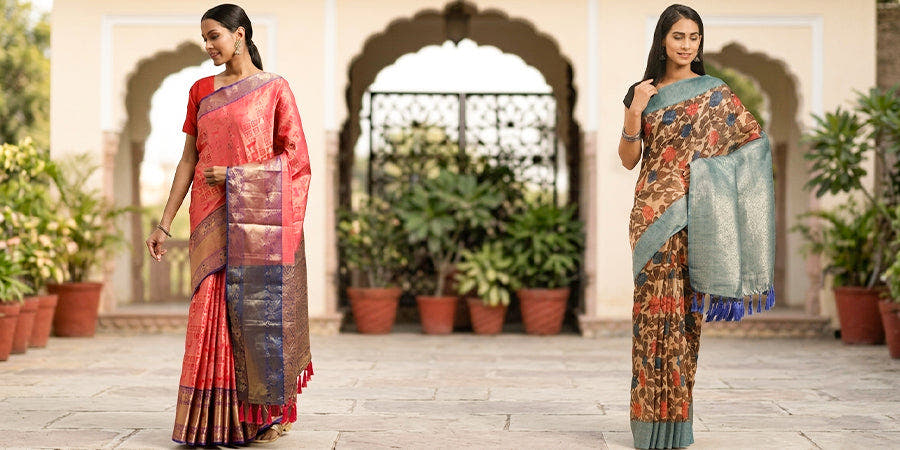
Shop Pattu Sarees
 Kanjivaram Gajari Colour Ethnic Motifs Silk Saree
₹ 1,250
 Navy Kanjivaram Tissue Saree With Gold Zari Weaving
₹ 1,250
 Kanjivaram Rama Colour Silk Blend Woven Design Saree
₹ 1,695
 Rust Red Kanjivaram Tissue Saree With Gold Zari Weaving
₹ 1,250
 Kanjivaram Silk Yellow Colour Geometric Print Saree
₹ 1,595
 Pastel Peach Kanjivaram Tissue Saree With Gold Zari Weaving
₹ 1,250
 Blush Pink Silk Kalamkari Print Saree with Navy Ikat Base
₹ 1,845
 Kanjivaram Burgundy Colour Silk Blend Woven Design Saree
₹ 1,695

Dharmavaram sarees are silk pattu sarees from Andhra Pradesh, known for broad contrast borders, rich zari and a soft, fluid body. Temple-style motifs often line the border and pallu. They suit weddings, pujas and festivals, and many shoppers pick them as a graceful alternative to heavier silks.
This guide explains what makes a Dharmavaram pattu saree distinctive, how to recognise the weave, how it differs from Kanjivaram, and when to wear it. It also covers care and a few simple buying checks, so you can choose with confidence.
What are Dharmavaram sarees?
Dharmavaram sarees take their name from Dharmavaram, a town in Andhra Pradesh long linked with pattu weaving. The name is also used for the style: a silk saree with a generous border, a decorated pallu and a body that is often kept simple so the border can stand out.
Shoppers often search for them as dharmavaram pattu sarees or dharmavaram silk sarees. All three phrases point to the same family of sarees, where silk and zari come together in a traditional South Indian format.
Please note that styles named after a place are often made in many centres today. When you shop, read each product description to see the fabric stated, because a saree can be described as Dharmavaram-style or silk blend rather than pure silk.
What makes the weave and border distinctive?
The first thing most people notice is the border. It is wide and usually in a colour that contrasts with the body, so a wine border might frame a mustard body, or a deep green might sit against rose pink. The contrast is what gives the saree its temple-like look.
The second feature is the zari. It is woven into the border and pallu in lines, checks or motifs, giving a gentle gleam rather than a loud shine. The pallu is often a richer, more detailed section, sometimes with a contrast shade of its own.
- Wide contrast border that frames the saree
- Zari work in the border and pallu
- Temple-inspired motifs such as lines, checks and traditional shapes
- A body that is plain or lightly patterned, so the border leads
- A soft fall that drapes easily in pleats
How is a Dharmavaram saree different from a Kanjivaram?
Both are South Indian pattu sarees, and both use silk and zari, so they are easy to confuse. The difference lies mainly in feel and design emphasis. Dharmavaram sarees are known for their wide contrast borders and a softer drape, while Kanjivaram sarees are known for a heavier, more structured look with bold zari work.
If you want a saree that feels lighter to carry through a long function, a Dharmavaram style is a sensible place to start. If you want a showpiece with a strong, stately body, many shoppers lean towards Kanjivaram.
Neither is better in every case. It depends on the occasion, how long you will be wearing it, and the look you like. Our guide to the types of pattu sarees compares several South Indian weaves side by side if you want to see more of them.
When should you wear a Dharmavaram saree?
These sarees sit comfortably between festive and formal. They are a natural choice for Telugu weddings, where a dharmavaram saree for wedding functions is a familiar and well-loved pick, whether you are family or a guest. Our Telugu wedding saree guide shows how different sarees fit different ceremonies.
They also work well for temple visits, house pujas, Ugadi, Diwali and other family gatherings. A rich border gives you the festive feel without needing a heavy body.
For a bride, a Dharmavaram saree can suit a smaller function such as a engagement or a puja ceremony, while the main ceremony may call for a more elaborate silk. Choose according to the dress code of the day and your comfort.
- Weddings and engagement ceremonies
- Temple visits and pujas
- Festivals such as Ugadi and Diwali
- Family gatherings and reunions
- Formal evenings where you want a traditional look
How do you style a Dharmavaram saree?
Let the border do the talking. Keep the blouse simple, either in the border colour or in a shade pulled from the zari. A contrast blouse can look striking, but a matching one gives a calm, classic finish.
For jewellery, temple-style gold pieces suit the look well. A pair of jhumkas, a short necklace and a few bangles are usually enough. Because the border is already strong, you do not need to add too many pieces.
Drape it in pleats that show off the border at the hem, and arrange the pallu so the detailed section is visible. You can also browse handloom sarees if you like the idea of woven textiles with a similar traditional character.
How do you care for it and choose a good one?
Silk and zari need gentle care. Dry cleaning is the safest choice for most pattu sarees. Between wears, air the saree in the shade, fold it with a soft cotton cloth and refold it along different lines now and then to avoid permanent creases.
When buying, check the fabric listed on the product page, look closely at the border for even weaving, and see how the pallu and body colours sit together. You can explore the full range in our Dharmavaram Pattu collection.
If you need help with an order, Vastranand states that returns are accepted within 22 days of delivery, and orders are packed in 2 to 3 days with 4 to 5 days on the way.
Read next
Frequently asked questions
Are Dharmavaram sarees pure silk?
Not always. Many sarees sold under this style are pure silk, while others are silk blends. The fabric should be stated on the product page, so read it before buying. A blend is a blend, and it can still be a lovely, lighter choice for festive wear.
Is a Dharmavaram saree good for a wedding?
Yes. A Dharmavaram saree for wedding functions is a popular choice, especially at Telugu weddings. The wide contrast border and zari give a festive look, and the softer drape makes it comfortable to wear through long ceremonies, for family and guests alike.
How is Dharmavaram different from Kanjivaram?
Both are South Indian pattu sarees with zari. Dharmavaram sarees are known for wide contrast borders and a softer drape, while Kanjivaram sarees usually have a heavier, more structured look. Your choice depends on the occasion and how much weight you want to carry.
How should I store a Dharmavaram silk saree?
Keep it folded in a soft cotton or muslin cloth, away from damp and direct sun. Air it occasionally in the shade and change the fold lines every few months. This protects the zari and prevents sharp creases from setting in the silk.
Shop sarees from this story
Kanjivaram Gajari Colour Ethnic Motifs Silk Saree
₹ 1,250
Navy Kanjivaram Tissue Saree With Gold Zari Weaving
₹ 1,250
Kanjivaram Rama Colour Silk Blend Woven Design Saree
₹ 1,695
Rust Red Kanjivaram Tissue Saree With Gold Zari Weaving
₹ 1,250
Kanjivaram Silk Yellow Colour Geometric Print Saree
₹ 1,595
Pastel Peach Kanjivaram Tissue Saree With Gold Zari Weaving
₹ 1,250
Blush Pink Silk Kalamkari Print Saree with Navy Ikat Base
₹ 1,845
Kanjivaram Burgundy Colour Silk Blend Woven Design Saree
₹ 1,695 Orange Colour Kalamkari Print Kanjivaram Zari Silk Saree
₹ 1,845
 Grey Silk Blend Kanjivaram Woven Saree with Pink Border
₹ 1,695
Watch these sarees in motion
Loved this story? The sarees behind it are waiting for you — handcrafted, factory-direct, delivered across India.
Shop best sellers ← Back to The Vastranand Journal