Shop Raw Silk Sarees
 Black Banarasi Raw Silk Ikkat Saree
₹ 1,450
 Peach Banarasi Raw Silk Ikkat Saree
₹ 1,450
 Black Crystal Raw Silk Kanchi Pattu Saree
₹ 1,450
 Pink Minakari Kanchi Pattu Raw Silk Saree
₹ 1,450
 Pink Minakari Paithani Raw Silk Saree
₹ 1,199
 Chiku Minakari Paithani Raw Silk Saree
₹ 1,199
 Rama Minakari Kanchi Pattu Raw Silk Saree
₹ 1,450
 Gajri Minakari Paithani Raw Silk Saree
₹ 1,199

To identify a pure Banarasi silk saree, start with the fabric content, then check the zari, the reverse side, the weight and the sheen. Pure silk and silk blends can look alike on a shelf, so ask for the fabric content in writing. Banarasi-style sarees copy the look of the weave, but the look alone does not tell you what the yarn is made of.
Many shoppers feel unsure at this point, and that is normal. This guide walks you through simple checks you can do in the shop or at home, and explains which words on a product page matter most. None of these checks needs special training, only a little patience and a few good questions.
What does pure silk mean for a Banarasi saree?
The word pure should describe the yarn, not the design. A pure silk saree is woven with silk yarn only. A silk blend uses silk together with another fibre, such as cotton, viscose or synthetic yarn. A blend is still a blend, even when it has a lovely finish, so it should be described as one.
Banarasi is also the name of a weaving tradition from Varanasi. Many sarees sold today are Banarasi-style, meaning they borrow the motifs, borders or zari work of that tradition. A Banarasi-style saree can be beautiful, but it is not the same claim as a saree made in Varanasi from pure silk. Read the product description carefully to see which one you are buying.
- Pure silk: the fabric content says silk, with no other fibre named.
- Silk blend: the label names silk along with another fibre, so the saree is a blend.
- Banarasi-style: the design follows the Banarasi look, but the fabric and place of making need to be confirmed separately.
How do I check the zari and the weave?
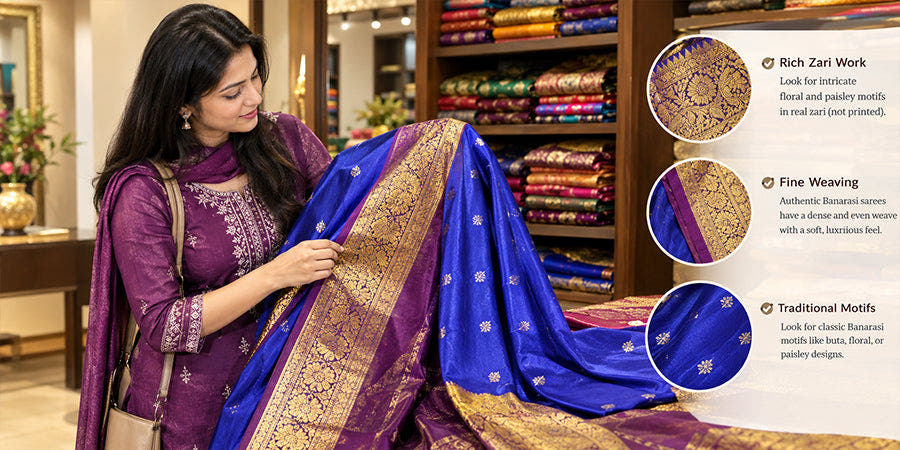
Zari is the metallic thread in the border, the pallu and the motifs. Look closely at it under daylight. Good zari has a clean, even sheen and the motifs look crisp on both the front and the back. Dull patches, flaking or a plasticky shine can point to lower-quality metallic thread.
Turn the saree over and look at the reverse. In a well-woven brocade, the motifs are visible from the back, though slightly different in colour and texture. Loose threads, uneven patterns or a messy back side suggest the weave was done quickly. Gently rub a small area of the border between your fingers to check whether the thread holds its shape.
- Check that motifs are clear and repeat evenly across the body and pallu.
- Look at the back: the design should be visible and neat.
- Check the joins between the border and the body for tight, straight stitching.
- Note any shedding of metallic thread on a white tissue or cloth.


How can I tell real silk by touch, sheen and weight?
Silk has a natural sheen that changes as you move the fabric. It does not look flat or glassy under a single light. Hold the saree up to a window or a lamp and turn it slowly. A good silk will shimmer softly, while a heavily shiny synthetic often looks the same from every angle.
Feel the weight and the drape. Silk usually falls with a soft, fluid movement and feels cool to the touch. Raw silk is different again: it has a slubbed, slightly uneven texture by design, which gives it a matte richness. Do not expect raw silk to feel like smooth satin, and do not assume a slub is a fault.
- Look for a sheen that shifts with the light rather than staying flat.
- Notice whether the drape is fluid or stiff.
- Remember that raw silk is meant to have a slubbed texture.
- Be cautious if the saree feels very light, very slippery and very shiny at the same time.
Which label and seller questions should I ask?
The fabric label and the product page are your most reliable guides. A clear label names the fibre content, the weave and the care instructions. If a listing says only Banarasi and does not mention the fabric, ask the seller directly before you buy.
Good sellers answer plain questions without fuss. Ask whether the saree is pure silk or a blend, what the zari is made of, and whether the design is Banarasi-style or a traditional Banarasi weave. A short, specific answer is a good sign.
- Ask: Is this pure silk or a silk blend?
- Ask: Is the border zari or a metallic thread?
- Ask: Is this a traditional Banarasi weave or a Banarasi-style design?
- Check the return window before buying. At Vastranand, returns are accepted within 22 days of delivery.
Which Vastranand sarees can I compare?
If you want to feel the difference between Banarasi-style and other silk weaves, our Raw Silk Sarees collection is a useful place to start. Raw silk has a textured surface, so it is a good way to practise noticing slubs, sheen and drape. Read each product page for its fabric description before you decide.
The Black Banarasi Raw Silk Ikkat Saree and the Peach Banarasi Raw Silk Ikkat Saree are both listed as Banarasi sarees at Rs 1,450. For comparison, the Pink Minakari Paithani Raw Silk Saree and the Cream Crystal Raw Silk Kanchi Pattu Saree are listed as silk sarees at Rs 1,199 and Rs 1,450. Paithani and Kanjivaram are separate weaving traditions, so compare them by feel and finish rather than by name.
What common mistakes should I avoid?
The most common mistake is trusting the word Banarasi alone. Another is judging silk by shine alone, since a bright finish can come from a synthetic fibre. Taking a little time with the label and the seller will save you from most disappointments.
If you are buying for a wedding or a festival, it helps to check the saree in daylight before the event and to keep the label and receipt with it. A careful check now means less worry on the day.
- Do not rely on the design or the name alone.
- Do not confuse a raw silk slub with a flaw.
- Do not ignore a missing fabric description.
- Do not buy in a hurry when the label is unclear.
See every design in our Raw Silk Sarees.
Read next
Frequently asked questions
Is every Banarasi saree made of pure silk?
No. Some Banarasi sarees are pure silk, while others are silk blends or Banarasi-style designs in other fibres. The fabric content on the label or product page tells you which one you are buying.
How can I tell if the zari is good quality?
Look for an even, clean metallic sheen and crisp motifs on both sides of the saree. Dull patches, flaking thread or a plastic-looking shine can suggest lower-quality metallic yarn.
Does a shiny saree mean it is pure silk?
Not necessarily. Silk has a soft sheen that shifts with the light. A very flat, glossy shine can come from synthetic fibres, so check the fabric content and feel the drape as well.
Is the slubbed texture of raw silk a defect?
No. Raw silk has a slubbed, slightly uneven surface by design, which gives it a matte richness. It is not a flaw, but it does mean the saree will not feel like smooth satin.
What should I ask a seller before buying a Banarasi saree?
Ask whether the saree is pure silk or a blend, what the zari is made of, and whether the design is a traditional Banarasi weave or a Banarasi-style look. Also check the return window, which at Vastranand is 22 days from delivery.
Shop sarees from this story
Black Banarasi Raw Silk Ikkat Saree
₹ 1,450
Peach Banarasi Raw Silk Ikkat Saree
₹ 1,450
Black Crystal Raw Silk Kanchi Pattu Saree
₹ 1,450
Pink Minakari Kanchi Pattu Raw Silk Saree
₹ 1,450
Pink Minakari Paithani Raw Silk Saree
₹ 1,199
Chiku Minakari Paithani Raw Silk Saree
₹ 1,199
Rama Minakari Kanchi Pattu Raw Silk Saree
₹ 1,450
Gajri Minakari Paithani Raw Silk Saree
₹ 1,199
 Rama Minakari Paithani Raw Silk Saree
₹ 1,199
 Rama Bandhej Pochampally Raw Silk Saree
₹ 1,450
Watch these sarees in motion
Loved this story? The sarees behind it are waiting for you — handcrafted, factory-direct, delivered across India.
Shop best sellers ← Back to The Vastranand Journal