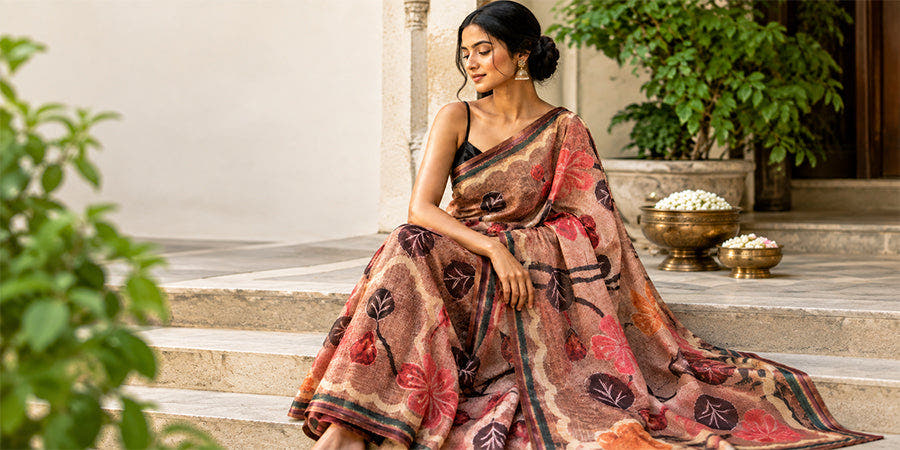
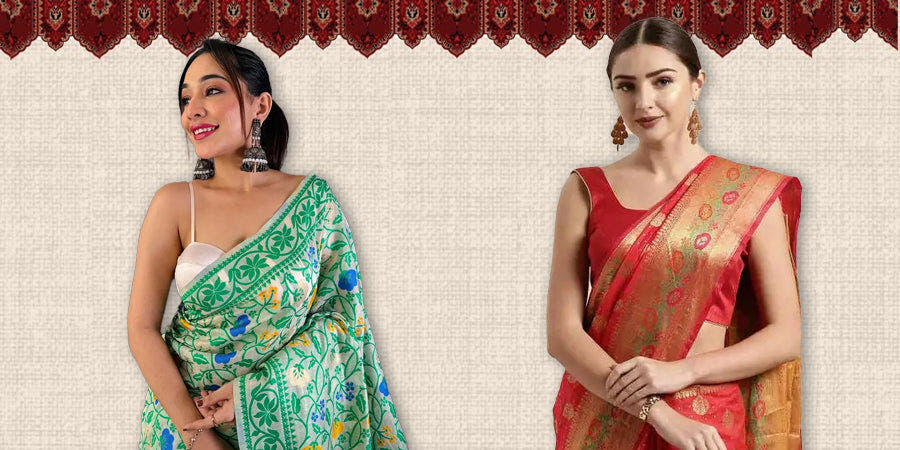
Some sarees are printed. Some are embroidered. And then there is Jamdani, where the pattern is woven into the cloth itself, thread by thread, while the fabric is still on the loom. If you have never owned one, this is your sign — and if you already love the look, here is everything you need to pick the right one.
1. What Is a Jamdani Saree?
Jamdani is a hand-loom weaving technique that goes back centuries to Dhaka and the Bengal region, where weavers add extra weft threads by hand to build small motifs — flowers, paisleys, geometric buttis — directly into the base fabric. Nothing is printed or embroidered on top; the design lives inside the weave, so it looks just as crisp on the reverse side as the front.
You will usually see it called Dhakai Jamdani, after its place of origin. The technique is so labour-intensive that a single saree can take a skilled weaver anywhere from a few days to several weeks, depending on how dense the motif work is across the body and pallu.
That patience is exactly what gives Jamdani its quiet, handcrafted look — no two pieces from the same weaver are ever perfectly identical. Browse the full Jamdani Sarees collection or the Dhakai Jamdani Saree collection to see the range of colours and grounds Vastranand carries.

2. Cotton Jamdani for Effortless Daily Wear
Pure cotton Jamdani is light, breathable and made for long days — pooja mornings, office hours or a simple family lunch. The motifs sit on a plain ground so the saree stays understated without ever looking plain.
Try the Royal Sky Blue Dhakai Cotton Jamdani Saree or the Mustard Yellow Dhakai Cotton Jamdani Saree, and explore more in the Cotton Sarees collection.

3. Cotton Silk Jamdani for Festive Occasions
Add a little silk to the yarn and the same weave gains a soft sheen that photographs beautifully under festival lights. Cotton silk Jamdani is the easy middle ground — dressier than pure cotton, lighter than pure silk.
Look at the Rich Orange Dhakai Jamdani Cotton Silk Saree, the Grey Dhakai Jamdani Cotton Silk Saree and the Jamdani Blue Colour Ethnic Motif Design Silk Cotton Saree, or browse the whole Cotton Silk Sarees collection.

4. Silk Jamdani for Weddings and Celebrations
When the occasion calls for more richness, silk Jamdani steps in. The extra weight and shine of silk let the woven motifs stand out even more, making these sarees a lovely pick for a wedding function or a big family celebration.
Consider the Ethereal Yellow Dhakai Jamdani Silk Saree, the Royal Blue Soft Dhakai Jamdani Silk Saree or the Gold Soft Dhakai Jamdani Silk Saree for your next event.

5. Linen Jamdani for Breezy Summer Style
Linen brings its own cool, textured hand to the Jamdani weave, so the saree drapes with a bit of structure while still feeling airy against the skin. It is a favourite for warm-weather weddings and daytime festive wear alike.
Explore the Jharokha Jamdani Cotton Linen Saree, the Classic Handloom Jamdani Linen Saree and the Sky Blue Jamdani Pallu Khadi Linen Saree, or see the full Linen Sarees collection.

6. Khadi Jamdani for a Handloom, Heritage Look
Khadi adds a raw, hand-spun texture that pairs beautifully with the fine Jamdani buttis, giving the saree an artisanal feel that is easy to spot from across a room. It is a lovely choice if you want your outfit to read as thoughtfully handmade.
The Heritage Khadi Jamdani Saree and the Yellow Jamdani Pallu Khadi Linen Saree both bring this handloom character home.

7. How to Spot a Genuine Jamdani Weave
Turn the saree over: since the motifs are woven, not printed, a real Jamdani will show almost the same pattern on the back as the front, just slightly less crisp. A printed imitation will look flat and blurry on the reverse, with the pattern visible only from the front.
Run your fingers over the motifs too — you should feel a very slight raised texture where the extra threads were added, as seen on the Traditional Yellow Dhakai Jamdani Saree. A genuine hand-loom Jamdani will also show tiny, natural irregularities in spacing between motifs, since every buti is placed by hand rather than machine-repeated.
These small variations are not flaws — they are the clearest sign you are looking at real handloom work. Compare a few pieces from the Jamdani Sarees collection to get a feel for it before you buy.
8. How to Style a Jamdani Saree
Because the motifs already do the talking, Jamdani pairs beautifully with a solid-colour blouse in a shade pulled from the border. Keep jewellery light for daytime looks and add temple gold or a statement neckpiece when you want to dress the same saree up for evening.
A cotton or cotton silk Jamdani works well for office and daytime festive plans, while a piece from the Festive Sarees collection like the Royal Blue Soft Dhakai Jamdani Silk Saree is ready for an evening function. Pleat the saree in the traditional Bengali style with the pallu draped loosely over one shoulder if you want the woven pallu motif to take centre stage.
If you are new to draping, a simpler front pleat with the pallu pinned neatly still lets the buttis across the body do all the visual work, so you never have to overthink the rest of the outfit.
9. Caring for Your Jamdani Saree
Hand-wash your Jamdani saree in cold water with a mild detergent, and always wash darker colours separately for the first few washes. Dry it in shade rather than direct sunlight to protect both the colour and the fine woven threads.
Store it folded in a soft cotton cloth and refold along different lines every few months so the weave does not weaken along one crease. This applies whether you own a piece from the Cotton Sarees collection or the Linen Sarees collection.
Why Shop Sarees at Vastranand
Vastranand sarees come to you through a factory-to-customer (F2C) model, which means you get factory-direct pricing without a chain of middlemen marking up every piece. Founded in 2017 in Surat by brothers Jigar and Ravi Viradiya, the brand has now served over 1 million happy customers across India.
Every order ships with cash on delivery available across India, and if a saree is not quite right, our easy returns make it simple to exchange or send it back. It is a straightforward way to shop for a Jamdani saree without leaving home.
Frequently Asked Questions
Is Jamdani the same as a Dhakai saree?
Yes — Dhakai Jamdani simply refers to the Jamdani weaving tradition associated with Dhaka, so the two names describe the same style of hand-loom saree.
Is a Jamdani saree comfortable for daily wear?
Cotton and cotton silk Jamdani sarees are light and breathable, making them a comfortable choice for everyday wear, while silk and linen versions suit festive days and special functions.
Can I wear a Jamdani saree to a wedding?
Yes, a silk Jamdani saree with rich motifs and a deeper colour works beautifully for a wedding function, especially when paired with statement jewellery.
How do I know if a Jamdani saree is handwoven and not printed?
Check the reverse side of the saree — a genuine woven Jamdani shows the same motif on the back, just slightly softer, while a printed copy only shows the pattern on the front.
How should I wash a Jamdani saree?
Hand-wash in cold water with a mild detergent, dry in shade, and store it folded in a soft cloth, refolding occasionally to protect the weave.
Ready to bring one home? Explore the complete Jamdani Sarees collection at Vastranand and find the weave, fabric and colour that suits your next occasion.
Shop sarees from this story
 Stylish Peach Colour Woven Design Cotton Saree
₹ 1,795
Stylish Peach Colour Woven Design Cotton Saree
₹ 1,795 Stylish Pista Colour Woven Design Cotton Saree
₹ 1,795
Stylish Pista Colour Woven Design Cotton Saree
₹ 1,795 Stylish Black Colour Woven Design Cotton Saree
₹ 1,795
Stylish Black Colour Woven Design Cotton Saree
₹ 1,795 Stylish Orange Colour Woven Design Cotton Saree
₹ 1,795
Stylish Orange Colour Woven Design Cotton Saree
₹ 1,795 Bollywood Mauve Colour Woven Design Cotton Saree
₹ 1,795
Bollywood Mauve Colour Woven Design Cotton Saree
₹ 1,795 Bollywood Black Colour Woven Design Cotton Saree
₹ 1,795
Bollywood Black Colour Woven Design Cotton Saree
₹ 1,795 Bollywood Orange Colour Woven Design Cotton Saree
₹ 1,795
Bollywood Orange Colour Woven Design Cotton Saree
₹ 1,795 Trendy Black Colour Saree Adorned with Printed Border
₹ 1,495
Trendy Black Colour Saree Adorned with Printed Border
₹ 1,495 Stylish Cotton Blend Woven Design Saree
₹ 1,795
Stylish Cotton Blend Woven Design Saree
₹ 1,795 Bollywood Peach Colour Woven Design Cotton Saree
₹ 1,795
Bollywood Peach Colour Woven Design Cotton Saree
₹ 1,795Watch these sarees in motion
Loved this story? The sarees behind it are waiting for you — handcrafted, factory-direct, delivered across India.
Shop best sellers ← Back to The Vastranand Journal