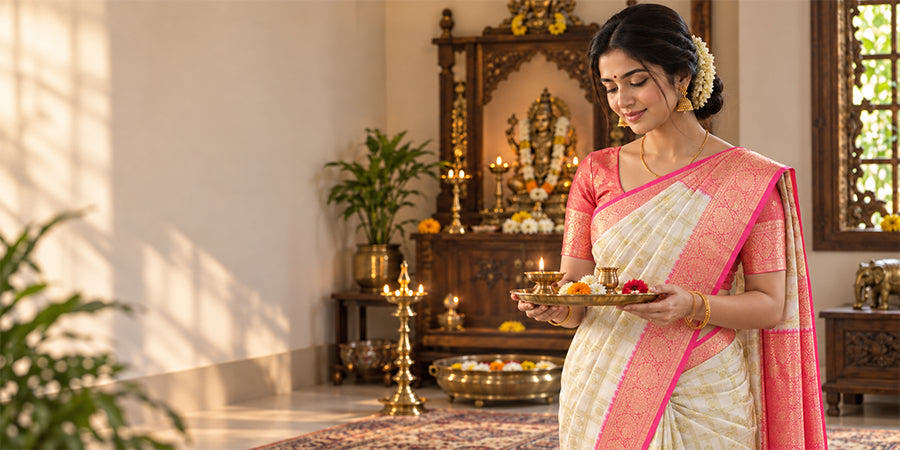
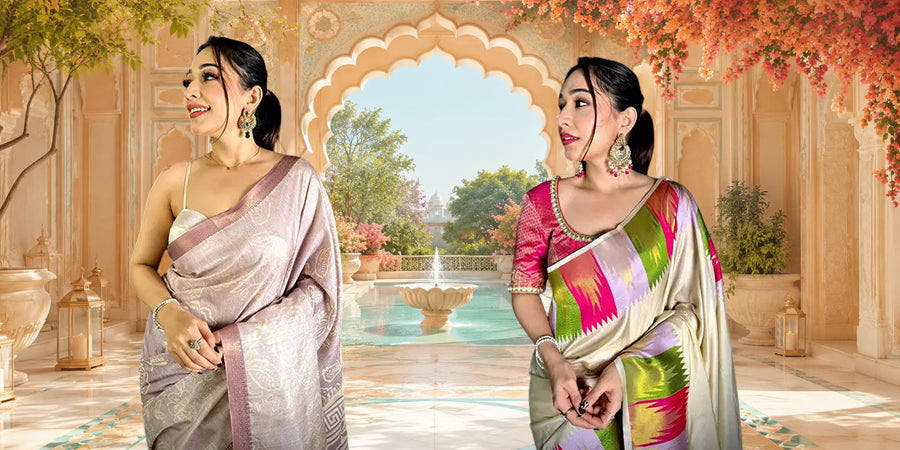
The short answer: Kanchipuram, Kanjivaram and Kanjeevaram are three spellings of the same saree — the grand silk weave of Kanchipuram, Tamil Nadu. “Kanchipuram” is the town's official name, “Kanjivaram” the popular anglicised form, and “Kanjeevaram” a common phonetic spelling. Same weave, same glory — whichever way you search it.
Why one saree has three names
The saree is named after Kanchipuram, the ancient temple town near Chennai where it has been woven for centuries. Say the town's name aloud and you'll hear how the variants happened: locals pronounce it roughly “Kanchi-puram,” which travelled north as “Kanjivaram,” while English writing stretched the vowels into “Kanjeevaram.” Shops in Chennai may spell it one way, a Mumbai boutique another, and Google sees all three daily — they are the same saree.
What makes this weave legendary
- The contrast border and pallu — traditionally woven separately and joined so firmly the joint outlives the saree (the korvai technique).
- Temple motifs — rudraksh beads, temple spires, peacocks and checks, woven not printed.
- The zari — broad, confident gold-toned borders that anchor every wedding photograph.
- The drape — structured and regal; a Kanchipuram-style saree stands with you rather than clinging.
Kanjivaram style at Vastranand — the honest version
Traditional pure-silk Kanchipurams from handloom houses cost tens of thousands of rupees. Vastranand's Kanjivaram collection takes a different, honest road: Kanjivaram-style sarees in soft silks and fine blends — the temple borders, the contrast pallus, the zari look — woven in Surat and sold factory-direct at a fraction of showroom prices. We never claim handloom-certified pure silk; what we promise is the Kanjivaram look, honest fabric labelling, and maker's pricing.
How to choose yours
For brides and weddings
Deep reds, maroons and golds with broad zari borders — our hand-picked bridal collection gathers the richest options.
For festivals and poojas
Classic combinations — mustard with green, purple with gold — from the festive collection carry the temple-town spirit.
For lighter days
Soft-silk Kanjivaram styles (like our bestselling baby pink) give the look with weekday comfort — see also soft silks.
Spotting quality in a Kanjivaram-style saree
Whatever the spelling, check the same things: a border that sits flat and heavy, motifs woven into the fabric rather than printed on top for zari-work styles, a pallu with real design density, and honest fabric disclosure from the seller. A trustworthy store tells you exactly what you're buying — it's the first thing we put on every product page.
Factory-direct from Surat
Every Kanjivaram-style saree at Vastranand ships factory-direct — weaving and dispatching since 2017 — usually within 2–3 working days, and is generally delivered across India in 4–5 working days after dispatch (festive periods can take 3–4 days longer), Cash on Delivery available, 48-hour easy exchange included. However you spell it, the search ends the same way: a great saree at the maker's price.
Vastranand — factory-direct sarees from Surat, where tradition meets trend.
Shop sarees from this story
 Pink Bandhej Printed Dola Silk Saree
₹ 750
Pink Bandhej Printed Dola Silk Saree
₹ 750
 Multi Satin Georgette Saree
₹ 1,050
Multi Satin Georgette Saree
₹ 1,050 Cream Colour Double Border Chex Weaving Banarasi Soft Silk Saree
₹ 999
Cream Colour Double Border Chex Weaving Banarasi Soft Silk Saree
₹ 999 White Soft Silk Pashmina Kashmiri Print Saree
₹ 999
White Soft Silk Pashmina Kashmiri Print Saree
₹ 999 Sky Blue Satin Georgette Saree
₹ 1,050
Sky Blue Satin Georgette Saree
₹ 1,050 Vibrant Soft Chinnon Chiffon Floral Saree
₹ 750
Vibrant Soft Chinnon Chiffon Floral Saree
₹ 750 Soft Silk Pashmina Kashmiri Print Saree
₹ 999
Soft Silk Pashmina Kashmiri Print Saree
₹ 999 Sky Blue Pochampally Patola Soft Silk Saree
₹ 1,050
Sky Blue Pochampally Patola Soft Silk Saree
₹ 1,050 Classic Floral Print Chiffon Saree
₹ 1,050
Classic Floral Print Chiffon Saree
₹ 1,050
 Cream Soft Silk Kanjivaram Saree
₹ 1,450
Cream Soft Silk Kanjivaram Saree
₹ 1,450Watch these sarees in motion
Loved this story? The sarees behind it are waiting for you — handcrafted, factory-direct, delivered across India.
Shop best sellers ← Back to The Vastranand Journal