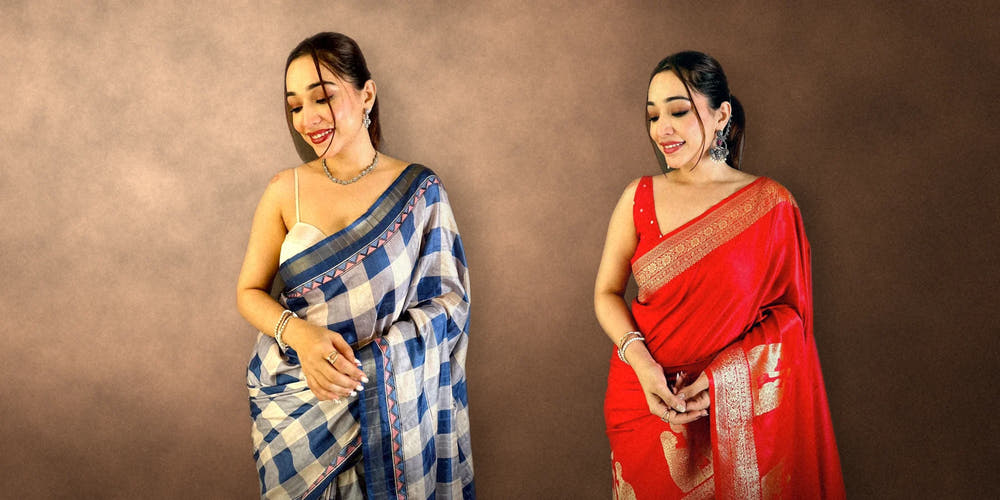
Shop Silk Sarees
 Off White Ethnic Motif Silk Blend Saree
₹ 1,995
 White Soft Silk Pashmina Kashmiri Print Saree
₹ 999
 Pink Bandhej Printed Dola Silk Saree
₹ 750
 Soft Silk Pashmina Kashmiri Print Saree
₹ 999
 Baby Pink Soft Silk Kanjivaram Saree
₹ 1,550
 Sky Blue Pochampally Patola Soft Silk Saree
₹ 1,050
 Cream White Soft Silk Gadwal Checked Saree with Zari Border
₹ 1,250
 Purple Dola Silk Pen Kalamkari Print Saree
₹ 750
Before buying pure zari kota silk sarees online, check four things: what the listing says about the fibre, how the zari is described, whether the square-check weave looks even in close photos, and what the return terms are. A clear listing answers all four without being asked.
Kota sarees are light, airy and slightly open in weave, so they behave differently from heavy silks. This guide walks you through reading a listing, judging zari, spotting a genuine weave, and caring for the saree once it arrives, so you can order with confidence and no guesswork.
What should I know before buying pure zari kota silk sarees online?
Start with the weave itself. Kota sarees take their name from Kota in Rajasthan and are known for a light, see-through feel and a pattern of tiny squares. The weave is meant to be airy, which is why these sarees suit warm weather and long functions where you do not want a heavy drape.
Next, understand the words on the listing. Kota is a weave, while silk, cotton and zari are materials. A saree can use silk, cotton or a mix of both, so the word pure should always come with a clear fibre description. If a page says only kota pure and nothing more, that is your cue to ask questions before paying.
Finally, think about where you will wear it. A zari kota saree looks graceful at daytime weddings, pujas, family lunches and festive gatherings. It is less suited to a night event that calls for a heavy, rich fall.
- Read the fibre line first: silk, cotton or a blend
- Look at close-up photos of the weave, not only the full drape
- Check the zari description for border and body
- Read the return terms before you pay
How do I read the fibre details on a listing?
A good listing tells you the material in plain words. It may say silk, silk and cotton, or a blend. If it does not, write to the seller and ask. Honest sellers answer quickly and without fuss.
Be careful with the word pure. It should describe one named fibre, and a blend is a blend. When a saree mixes silk with cotton or another yarn, it should be described that way. This is not a flaw, because blends are often lighter and easier to maintain, but you should know what you are paying for.
Also look for the weave name used correctly. A saree described as kota-style or inspired by Kota weaves is telling you the design follows the look, which is a fair way to describe it. Clear naming is a sign of a seller who respects the buyer.
- Ask for the fibre in words, not just a category label
- Treat blends as blends, and judge them on feel and finish
- Note whether the listing says kota or kota-style
How can I judge the silk zari work from photos?
Silk zari is the metallic thread work that gives a kota saree its glow, usually on the border, the pallu and sometimes in fine lines through the body. In photos, look at how the zari sits. It should lie flat and even along the border, without gaps, loops or loose ends.
Zoom in on the pallu. Motifs should be clean at the edges and balanced across the width. Uneven motifs or patchy shine in a product photo are worth a question to the seller.
Colour matters too. Zari can look gold, silver or antique, and the tone changes with light. Ask for a photo in daylight if the listing shows only studio shots. A warm gold zari on a soft pastel kota is a classic pairing, while a muted antique tone suits deeper shades.
- Zari should sit flat and even along the border
- Pallu motifs should have clean edges
- Ask for a daylight photo if the shine looks too bright
- Match zari tone to the base colour for a calm finish
What does a genuine kota weave look like?
The signature of a kota weave is its small square checks, often called khat. They form a light grid that gives the fabric a breathable, slightly open texture. In a close photo the squares should look even, with a pleasant crispness rather than a flat, printed look.
The fabric should feel soft but have a little body. Because the weave is open, it will not feel dense like a Kanjivaram or a heavy Banarasi. If a listing shows a saree that looks thick, tightly woven and glossy all over, it is probably a different fabric being described with a familiar name.
If you enjoy the lighter side of silk, our stylists also suggest looking at other weaves with a gentle drape, such as dola silk, which has its own soft shine and easy fall.
- Even small square checks across the body
- Light, airy feel with a little crispness
- Soft drape that does not look heavy or stiff
How do I choose the right kota silk saree for the occasion?
Think of the event first and the colour second. For a daytime wedding or a ceremony, a kota silk saree with a rich zari border in a soft shade looks graceful and comfortable through long hours. For a puja or a family gathering, a simpler border keeps the look calm.
Pair it with a blouse that has some structure. Because kota is light, a well-fitted blouse in a contrast or matching tone helps the whole look hold its shape. Light jewellery usually works better than heavy sets, since the zari already adds shine.
If you are still deciding between silk families, browse a few before you commit. Our silk sarees collection shows the range, and the silk sarees for wedding collection helps if you are dressing for a ceremony. For something with a firmer, textured look, raw silk sarees are another route to explore. If you are working to a limit, our silk sarees under 1500 collection is a place to begin.
- Daytime wedding: richer zari border in a soft shade
- Puja or family event: lighter border, calm colour
- Always pair with a well-fitted, structured blouse
Which tips help when ordering pure zari kota silk sarees online?
Our pure zari kota silk sarees online tips come down to a few habits. Read the full description, study every photo, and compare the colour in different lights. If something is unclear, message the seller before you order rather than after.
Check the shipping and return terms too. At Vastranand, orders are packed in 2-3 days and take 4-5 days on the way, and returns are accepted within 22 days of delivery. Whichever shop you choose, make sure the terms are written down and easy to find.
When the saree arrives, open it in daylight and check the weave, the zari and the finish against the listing. Do this soon after delivery so you have time to decide within the return window.
- Read every line of the description before ordering
- Ask questions early, not after delivery
- Confirm return terms in writing
- Inspect the saree in daylight on arrival
How do I care for a kota silk saree after buying it?
Kota sarees are delicate, so gentle care keeps them looking fresh. Dry cleaning is the safest choice for sarees with zari. If you must wash at home, use cool water and a mild detergent, and never wring or scrub the zari.
Store the saree folded in a soft cotton or muslin cloth, away from damp. Refold it along different lines every few months so the creases do not set and weaken the threads. Keep it apart from perfumes and sprays, since they can leave marks on a light fabric.
Iron on a low setting with a cloth over the saree, and avoid pressing directly on the zari. A little care at each step means a kota saree can serve you through many seasons.
- Prefer dry cleaning for zari work
- Store in soft cotton or muslin, away from damp
- Refold along new lines now and then
- Iron on low heat with a cloth between
Read next
- our silk sarees collection
- silk sarees for wedding
- raw silk sarees
- dola silk sarees
- silk sarees under 1500
Frequently asked questions
How can I tell if a kota silk saree is genuine?
Look for small, even square checks, a light and airy feel, and a clear fibre description on the listing. The zari should sit flat along the border. If the fabric looks thick and glossy all over, or the seller cannot name the fibre, ask for more details before you order.
Is kota silk good for weddings?
Yes, especially for daytime ceremonies and long functions, because it is light and breathable. Choose a saree with a rich zari border and a soft shade, and pair it with a structured blouse. For a heavier, grander drape at night events, a richer silk may suit better.
Does the word pure always mean pure silk?
No. Pure should describe one named fibre, and a blend should be called a blend. Kota sarees may use silk, cotton or a mix. Always read the fibre line, and ask the seller in writing if the listing is unclear.
How should I wash a zari kota saree?
Dry cleaning is the safest option because zari is delicate. If you wash at home, use cool water and mild detergent, avoid wringing or scrubbing, and dry in shade. Iron on low heat with a cloth over the saree, never directly on the zari.
What return and delivery terms does Vastranand offer?
Vastranand packs orders in 2-3 days and they take 4-5 days on the way. Returns are accepted within 22 days of delivery. Inspect your saree in daylight soon after it arrives so you can decide comfortably within that window.
Shop sarees from this story
Off White Ethnic Motif Silk Blend Saree
₹ 1,995
White Soft Silk Pashmina Kashmiri Print Saree
₹ 999
Pink Bandhej Printed Dola Silk Saree
₹ 750
Soft Silk Pashmina Kashmiri Print Saree
₹ 999
Baby Pink Soft Silk Kanjivaram Saree
₹ 1,550
Sky Blue Pochampally Patola Soft Silk Saree
₹ 1,050
Cream White Soft Silk Gadwal Checked Saree with Zari Border
₹ 1,250
Purple Dola Silk Pen Kalamkari Print Saree
₹ 750 Radiant Harmony Katan Silk Saree
₹ 999
 Black and White Check Katan Silk Saree with Gold Zari Border
₹ 999
Watch these sarees in motion
Loved this story? The sarees behind it are waiting for you — handcrafted, factory-direct, delivered across India.
Shop best sellers ← Back to The Vastranand Journal