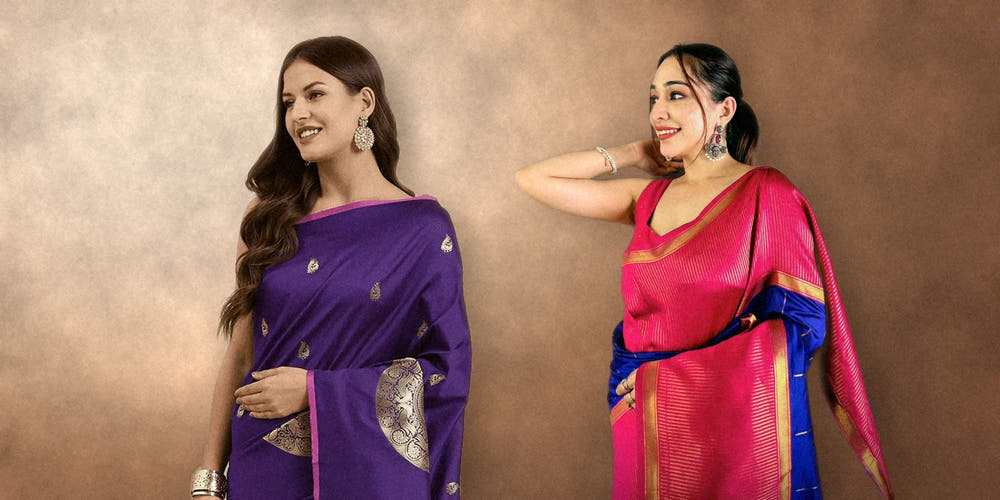
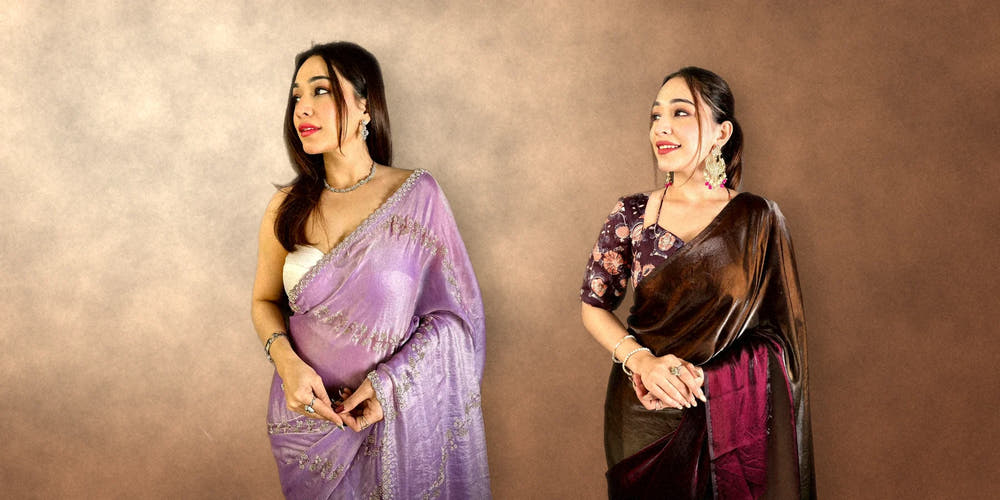
Shop Kalamkari Sarees
 Designer Kalamkari Print Pattu Banarasi Silk Saree
₹ 1,495
 Cream Red Banarasi Silk Kalamkari Print Saree with Zari Pallu
₹ 1,495
 Lavender Colour Satin Kota Doria Digital Kalamkari Zari Pallu
₹ 1,495
 Pink Colour Show Stopper Soft Silk Kalamkari Saree
₹ 1,250
 Silver Colour Satin Kota Doria Digital Kalamkari Zari Pallu
₹ 1,495
 Blue Colour Geometric Print Saree With kalamkari Print Design
₹ 1,250
 Maroon Colour Double Border Chex Weaving Banarasi Soft Silk Saree
₹ 999
 Grey Colour Satin Kota Doria Digital Kalamkari Zari Pallu
₹ 1,495
A kalamkari saree is a cotton or silk saree carrying natural-dye designs from Andhra Pradesh, either drawn by hand with a bamboo pen (the Srikalahasti way) or stamped with carved wooden blocks (the Machilipatnam way). Knowing which craft you are looking at, and how the cloth was worked, makes buying far easier.
Many shoppers search for kalamkari and are unsure what they will receive. The word covers hand-painted pieces, block-printed pieces and, increasingly, digital prints in the same style. This guide explains each, step by step, so you can look at a saree and read it with confidence.
What is a kalamkari saree, and where does the name come from?
If you have wondered what is a kalamkari saree, the name itself is a good start. Kalam means pen and kari means work, so the word simply means pen work. The craft began as a way of telling stories on cloth, with scenes from the Ramayana, the Mahabharata and the Puranas, and with trees, flowers and peacocks filling the spaces between.
Over time the same art moved from temple hangings and wall cloths onto sarees, dupattas and blouse pieces. Today the motifs you see most often are the tree of life, paisleys, lotus flowers, birds and mythological figures, usually in earthy reds, indigo blues, mustard, green and black.
What ties every real kalamkari together is the colour. Traditionally the colours come from natural sources such as plants, roots and iron-based solutions, not from bright synthetic dyes. That gives the cloth its softer, deeper tones.
How does a kalamkari saree differ: Srikalahasti or Machilipatnam?
Andhra Pradesh has two well-known kalamkari traditions, and the Srikalahasti vs Machilipatnam kalamkari question is really a question of tools. One is drawn, the other is stamped. Neither is lesser; they simply suit different tastes.
Srikalahasti work is freehand. An artisan holds a pointed bamboo pen (the kalam) wrapped with cloth that holds the dye, and draws outlines and fills in colour by hand. Its roots are in temple storytelling, so you will often see deities, epic scenes and detailed figures. Because every line is drawn, no two sarees are exactly alike, and small variations in a curve or a leaf are part of its charm.
Machilipatnam work, also linked to the Pedana area near the town, relies on carved wooden blocks. The blocks are dipped in dye and pressed onto cloth, often in several rounds for several colours. This style leans towards repeating floral creepers, vines, buta and paisley patterns, which is why it flows so well across a saree body.
Here is a quick way to hold the two apart:
- Srikalahasti: drawn with a pen, fine lines, narrative scenes, slight variations from one repeat to the next.
- Machilipatnam: stamped with blocks, rhythmic floral and vine patterns, repeats that match closely.
- Both: natural-dye colouring is the traditional standard, with a muted, earthy palette.
- Both can also be combined, with block outlines filled in by hand, so you may see mixed pieces.
How are natural dyes used in kalamkari?
The dyeing is a long, patient process, and it is part of why traditional kalamkari is valued. In the traditional method the cloth is first treated so that it will hold colour, then outlines are drawn or printed, and colours are built up in stages with washing between them. Many stages involve water, so the craft has historically been settled near rivers and clean water.
Colours are drawn from familiar natural sources. Indigo gives blue, madder-type roots and alum give reds, pomegranate rind and similar sources give yellows, and an iron-based solution gives black. Greens are usually made by layering blue over yellow.
Because the colours are plant-based, they tend to look warm and slightly soft, not neon. They may also settle and mellow over time. If a saree claims kalamkari but shows very bright, flat, glossy colour, it is worth asking more questions.
Kalamkari saree hand painted or printed: how can you tell?
This is the question most buyers actually need answered. When you ask whether a kalamkari saree is hand painted or printed, look at the cloth closely, in daylight if you can. A few checks work well in practice.
None of them is a guarantee on its own, so use them together and treat them as clues, not proof.
- Look at the lines. Hand-drawn outlines have tiny wobbles, thicker and thinner stretches, and slightly uneven joins. Digital prints look perfectly uniform and sharp, almost like a photograph.
- Compare the repeats. Hand-drawn motifs differ slightly from one to the next. Block prints repeat very closely but show small signs of stamping, such as faint overlaps or slight misalignment at edges.
- Check the colour fill. In handwork, colour sits a little unevenly inside the lines and may bleed softly at an edge. Digital work shows flat, even fill with crisp boundaries.
- Turn the saree over. In dyed and painted cloth, the colour usually shows through on the reverse. In many digital prints the back looks paler or the surface feels coated.
- Feel the surface. Natural-dye work on cotton or silk feels like fabric. A plasticky or stiff layer of colour on top suggests surface printing.
- Notice the palette. A limited, earthy range with deep reds, indigo and black is typical of natural dyes. Many bright shades of equal intensity point towards synthetic or digital colour.
- Read the description. A seller who is proud of true handwork will usually say so clearly, naming the craft, the technique and the fabric.
What about digital prints and kalamkari-style sarees?
Not every saree with a kalamkari look is made the traditional way, and that is fine as long as it is described honestly. Many sarees are printed in kalamkari-inspired designs, using screens or digital machines. They can be lovely, light on the pocket and easy to wear, but they are a different product from a hand-drawn or hand-blocked piece.
The words to watch for are inspired by, style and print. A saree called a kalamkari print is telling you it is printed. A saree described as hand-painted should be able to say who or where it was painted and with what method. If the details are missing, do not assume.
It also helps to think about what you want. For a gift or a weekday saree, a well-made print in a kalamkari design may be exactly right. For a collector's piece or a special occasion where the craft itself matters, ask for the technique in plain words before you decide.
Which fabric and occasion suit a kalamkari saree?
Kalamkari is most often seen on cotton and on silk. Cotton is breathable and easy for long days, so it suits offices, college, daytime gatherings and warm weather. Silk gives the same motifs a richer fall, which is why it is chosen for festivals, pujas and family functions.
Because the designs are already busy and detailed, styling can stay simple. A plain contrast blouse, or a solid one that picks up one colour from the saree, usually looks best. Oxidised or temple-style jewellery sits well with the earthy palette, and a bold border can carry the whole look without extra accessories.
If you like exploring crafts, our Craft Stories collection is a good place to see how regional art travels onto sarees. For comfortable everyday weaves, browse the Handloom Sarees collection, and for a blend of softness and body, look at Silk Cotton Sarees.
How should you care for a kalamkari saree?
Natural dyes ask for a gentle hand. For the first wash, many people prefer dry cleaning or a very quick cold rinse with mild detergent, done separately so that any loose colour does not touch other clothes. Avoid soaking for long, wringing hard or scrubbing the motifs.
Dry it in shade, because strong sun can fade natural colours over time. Iron on the reverse at a suitable setting for the fabric, and store it folded in a soft cotton cloth, away from damp.
If you are unsure of the fabric, check the label or ask before washing. Gentle handling is the simplest way to keep the colours looking good for years.
If you want a wider view of saree types before choosing, our guide to the most popular types of sarees in India is a helpful companion. And should a saree not feel right when it reaches you, Vastranand accepts returns within 22 days of delivery.
Read next
- Craft Stories collection
- Handloom Sarees collection
- Silk Cotton Sarees
- most popular types of sarees in India
Frequently asked questions
Is kalamkari always hand painted?
No. Kalamkari covers hand-drawn work from Srikalahasti, hand-blocked work from Machilipatnam, and many modern prints made in the same style. The name alone does not tell you the method, so check the description and look closely at the lines, repeats and colour before you buy.
Which is better, Srikalahasti or Machilipatnam kalamkari?
Neither is better; they are different crafts. Srikalahasti is drawn freehand with a pen and often shows story scenes. Machilipatnam uses carved wooden blocks and favours floral and vine patterns. Choose by the look you like and how much handwork you want in the piece.
Do kalamkari sarees fade or bleed in the wash?
Natural dyes can soften with time and may release a little colour, especially in the first wash. Wash separately in cold water with mild detergent, avoid long soaking and strong sun, or choose dry cleaning. Gentle care helps the colours stay rich.
Can I wear a kalamkari saree to a wedding?
Yes, particularly in silk, with a solid or contrast blouse and simple traditional jewellery. Cotton kalamkari suits daytime functions, pujas and casual family gatherings. For a bridal or main-ceremony look, silk with a rich border is the more usual choice.
How do I know a kalamkari saree is not a digital print?
Look for small irregularities in outline and repeats, colour that shows through on the back, and a soft, earthy palette. A photographic sharpness, perfectly identical repeats and a pale reverse suggest digital printing. If still unsure, ask the seller to describe the technique.
Shop sarees from this story
Designer Kalamkari Print Pattu Banarasi Silk Saree
₹ 1,495
Cream Red Banarasi Silk Kalamkari Print Saree with Zari Pallu
₹ 1,495
Lavender Colour Satin Kota Doria Digital Kalamkari Zari Pallu
₹ 1,495
Pink Colour Show Stopper Soft Silk Kalamkari Saree
₹ 1,250
Silver Colour Satin Kota Doria Digital Kalamkari Zari Pallu
₹ 1,495
Blue Colour Geometric Print Saree With kalamkari Print Design
₹ 1,250
Maroon Colour Double Border Chex Weaving Banarasi Soft Silk Saree
₹ 999
Grey Colour Satin Kota Doria Digital Kalamkari Zari Pallu
₹ 1,495 Purple Colour Satin Kota Doria Digital Kalamkari Zari Pallu
₹ 1,495
 Green Colour Block Print Saree With kalamkari Print Pallu
₹ 1,250
Watch these sarees in motion
Loved this story? The sarees behind it are waiting for you — handcrafted, factory-direct, delivered across India.
Shop best sellers ← Back to The Vastranand Journal