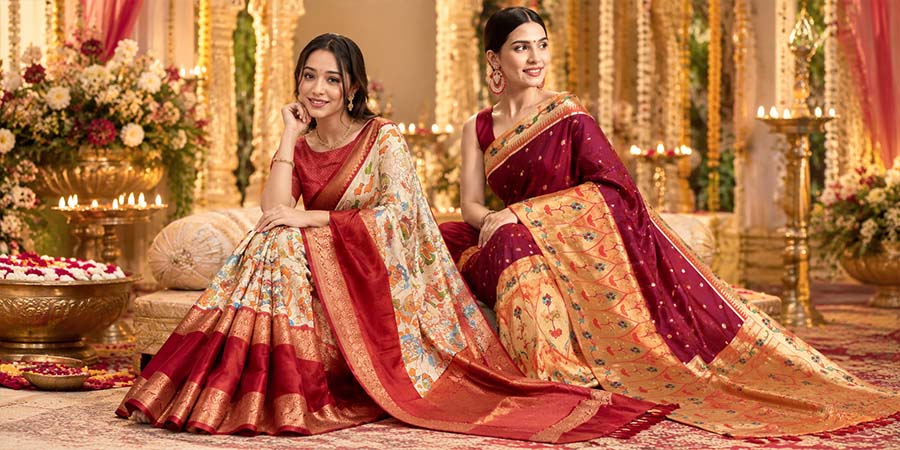
Kantha is one of India's oldest embroidery traditions, and it rarely gets the spotlight it deserves next to bigger names like Banarasi or Kanjivaram. If you love sarees with a story stitched into every thread, this guide walks you through what Kantha work really is, how it is made, and how to spot authentic pieces. Along the way, we will show you real Tussar silk sarees at Vastranand that carry this gentle, hand-worked craft forward.
1. What Is Kantha Work? Bengal's 200-Year-Old Running Stitch
Kantha began in rural Bengal, where women layered and quilted old cotton saris together with simple running stitches to give worn fabric a new life. What started as a thrifty household skill slowly grew into a recognised embroidery art, passed down from mother to daughter across generations. Today, skilled artisans use the same running stitch on fresh fabric rather than recycled cloth, turning it into borders, florals and flowing motifs.
You will usually see Kantha work along the border and pallu of a saree, done in contrasting thread that catches the light every time the fabric moves. It is a quieter kind of embellishment compared to zari or sequin work, but it carries just as much craftsmanship. You can explore more of this heritage in our Bengali sarees collection.
2. How Kantha Patterns Are Hand-Stitched, Thread by Thread
Traditional Kantha uses a simple running stitch repeated in close rows to build up a motif, so the finished design looks almost drawn rather than embroidered. There is no machine shortcut for this look, which is why it takes patience, a steady hand and real skill to finish even a single border well. Every artisan brings a slightly different rhythm to the stitch, so no two Kantha pieces turn out exactly alike.
On Vastranand sarees, this stitch is often used as a border detail on Tussar silk, a fabric with a natural, slightly uneven texture that lets the embroidery stand out rather than blend in. The contrast between the raw silk surface and the fine stitching is part of what makes this pairing so popular for festive wear.
3. Tussar Silk and Kantha: A Pairing Made for Festive Days
Tussar silk has a soft sheen and a slightly nubby texture that pairs beautifully with the raised look of Kantha stitching. These sarees drape easily, breathe well through the day, and work nicely for daytime functions, pujas or a festive lunch with family. The earthy tones typical of Tussar also make the red or dark-thread Kantha border pop without feeling loud.
Try the Radiant Pink Tussar Silk Digital Print Saree, the Rama Tussar Silk Digital Print Saree, or the Grey Tussar Silk Digital Print Saree, each finished with a rich red-thread Kantha stitch border along the pallu.

4. Kalamkari Motifs Meet Kantha Borders
Some of the prettiest Kantha-bordered sarees pair the stitch with Kalamkari-style prints, so you get hand-painted motifs across the body and hand-stitched detail along the edge. It is a lovely way to wear two distinct Indian craft traditions in a single drape, without either one overpowering the other. The combination works especially well for women who want a saree that feels traditional but still conversation-worthy.
Look at the Turquoise Blue Tussar Silk Kalamkari Print Saree, the Pista Tussar Silk Kalamkari Print Saree, and the Light Brown Tussar Silk Kalamkari Print Saree, all drawn from our wider Kalamkari sarees edit.

5. Checks and Kantha: A Fresh Take on Tradition
Checked weaves are having a moment across Indian fashion right now, and Kantha work gives them a handcrafted edge that feels anything but basic. The clean lines of a check pattern create a lovely backdrop for the softer, organic curves of hand-stitched motifs. These sarees make easy picks when you want something rooted in tradition that still feels current and fresh.
The Cocoa Checks Kantha Border Tussar Saree and the Elegant Soft Tussar Kantha Print Saree both bring this pairing to life, with a soft, textured drape that moves beautifully.

6. How to Style Your Kantha Saree
Let the embroidery do the talking. A plain or lightly textured blouse in a solid shade from the saree's palette keeps the focus on the stitch work, while gold or oxidised jewellery adds just the right festive touch without competing with the detailing.
For daytime events, simple drop earrings and a neat bun work beautifully with the understated charm of Kantha. For evening functions, add a statement neckpiece, a bold bindi, and let the pallu fall loose over one shoulder so the embroidered border gets the attention it deserves.
7. Kantha Beyond the Saree: Everyday Kurtis
If you love the look but want something more suited to everyday wear, Kantha embroidery translates beautifully onto comfortable cotton kurtis as well. The soft, breathable fabric keeps you comfortable through long work days, while the hand-stitched detail adds a touch of heritage to an otherwise simple silhouette.
Try the Mul Cotton Kantha Work V Neck Kurti or the Elegant Kantha Work Mul Cotton Kurti, both crafted in breathable mul cotton that feels light even through a full day of wear.
8. Caring for Your Kantha Embroidery
Hand-wash Kantha-worked cotton pieces separately in cool water with a mild detergent, or dry-clean silk sarees to protect both the fabric and the embroidery thread. Always dry them in shade rather than direct sunlight, since strong sun can fade the thread colour over time.
Store your Kantha sarees and kurtis folded in muslin or cotton cloth rather than plastic, and refold them every few months along a different line to avoid permanent creases. When ironing, work on the reverse side and avoid pressing directly over the stitched border, so the thread keeps its texture and sheen wash after wash.
Why Shop Sarees at Vastranand
Vastranand sarees come to you factory-direct through our F2C model, which means you get genuine craftsmanship without layers of middleman markup. Founded in Surat in 2017 by brothers Jigar and Ravi Viradiya, we have grown to serve over 1 million happy customers across India. Every order comes with cash on delivery available nationwide and easy returns, so you can shop with confidence even when you cannot try a saree on in person.
Frequently Asked Questions
What is Kantha work on a saree?
Kantha is a traditional Bengali embroidery technique that uses simple running stitches, repeated in close rows, to create borders and motifs entirely by hand.
Which fabric is best for a Kantha-embroidered saree?
Tussar silk is a popular choice because its naturally textured surface complements the raised look of Kantha stitching, though soft cotton is used for everyday pieces too.
Is Kantha work suitable for daily wear?
Yes. Lighter Kantha pieces, especially on cotton kurtis, are comfortable enough for daily or office wear, while Tussar silk sarees are better suited to festive occasions.
How do I wash a Kantha saree without damaging the embroidery?
Hand-wash cotton pieces gently in cool water or dry-clean silk sarees, dry them in shade, and iron on the reverse side to protect the stitching.
Can Kantha work be paired with other print styles?
Yes, it pairs well with Kalamkari prints and checked weaves, as seen in several Vastranand sarees that bring both crafts together in one drape.
Ready to bring this heritage stitch into your wardrobe? Browse the full Tussar silk sarees collection at Vastranand and find a Kantha-worked piece that feels like yours.
Shop sarees from this story
 Soft NarayanPaith Paithani Saree
₹ 1,695
Soft NarayanPaith Paithani Saree
₹ 1,695 Royal Minakari Weave Soft Organza Paithani Saree
₹ 1,550
Royal Minakari Weave Soft Organza Paithani Saree
₹ 1,550 Cream Minakari Weave Soft Organza Paithani Saree
₹ 1,550
Cream Minakari Weave Soft Organza Paithani Saree
₹ 1,550 Yellow Jamdani Pallu Khadi Linen Saree
₹ 1,450
Yellow Jamdani Pallu Khadi Linen Saree
₹ 1,450
 Purple Soft Kota Crepe Contrast Border Saree
₹ 850
Purple Soft Kota Crepe Contrast Border Saree
₹ 850
 Red Soft Kota Crepe Contrast Border Saree
₹ 850
Red Soft Kota Crepe Contrast Border Saree
₹ 850
 Burgundy Colour Ikkat Print Saree With kalamkari Block Print Design
₹ 1,250
Burgundy Colour Ikkat Print Saree With kalamkari Block Print Design
₹ 1,250 Elegant Cotton Feel Pastel Jamdani Saree
₹ 1,700
Elegant Cotton Feel Pastel Jamdani Saree
₹ 1,700 Royal Blue Soft Dhakai Jamdani Silk Saree
₹ 595
Royal Blue Soft Dhakai Jamdani Silk Saree
₹ 595 Black Dhakai Jamdani Cotton Silk Saree
₹ 595
Black Dhakai Jamdani Cotton Silk Saree
₹ 595Watch these sarees in motion
Loved this story? The sarees behind it are waiting for you — handcrafted, factory-direct, delivered across India.
Shop best sellers ← Back to The Vastranand Journal