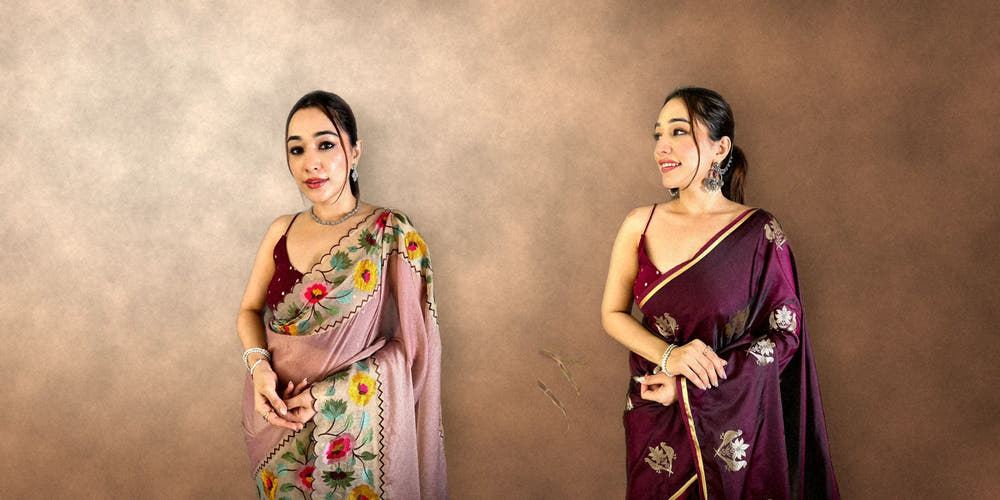
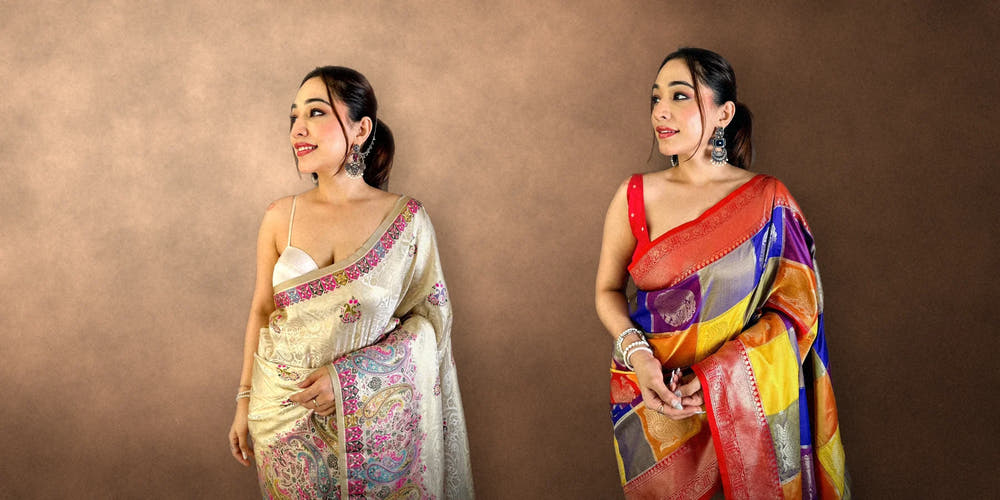
Shop our best sellers
 Pink Bandhej Printed Dola Silk Saree
₹ 750
 Multi Satin Georgette Saree
₹ 1,050
 Cream Colour Double Border Chex Weaving Banarasi Soft Silk Saree
₹ 999
 White Soft Silk Pashmina Kashmiri Print Saree
₹ 999
 Sky Blue Satin Georgette Saree
₹ 1,050
 Peach Ombre Chinnon Chiffon Floral Print Saree with Pink Pallu
₹ 750
 Soft Silk Pashmina Kashmiri Print Saree
₹ 999
 Sky Blue Pochampally Patola Soft Silk Saree
₹ 1,050
Before buying from the nearest saree shop, check four things: how honestly the staff name the fabric, how the saree drapes and feels in daylight, what the return and exchange terms are, and whether you can reach the shop after you buy. Closeness is useful, but it should never replace these checks.
A saree is a considered purchase, often for a wedding, a festival or a gift. A shop that is five minutes away is convenient, yet convenience alone does not tell you about quality. This guide, written by our stylists, shows you what to look for in a store, what to ask, and how an online shop can give you the same confidence.
What should I know before buying from the nearest saree shop?
Start with the plain answer: the nearest saree shop is only a good choice if it is honest about what it sells. That means the staff can tell you the fabric, the weave or print technique, and whether a saree is handloom or machine-made. If an answer sounds vague, ask again in simpler words. A good seller is happy to explain.
Next, think about why you are buying. A saree for daily office wear needs very different things from one for a wedding. Decide your occasion, your colour range and how much time you have before you need it. Knowing this keeps you from being led towards whatever is on display near the counter.
Finally, remember that a nearby shop has a limited shelf. It can only show you what it has stocked, and that may be a small part of what exists. Treat the first visit as a way to feel fabrics, not as a deadline to decide.
- Ask for the fabric name and the weave or print method.
- Decide your occasion and colour range before you go.
- Feel several sarees, not only the ones placed in front.
- Do not decide under pressure on the first visit.
How do I judge fabric and weave inside the shop?
Touch is your best tool. Hold the saree and let it fall from your hand. Silk and silk blends should fall softly with some body, while organza should hold a crisp, airy shape. Cotton and handloom weaves feel breathable and slightly textured. If a saree feels stiff or scratchy in a way the seller cannot explain, take note.
Look at the saree in natural light if you can, by the door or a window. Shop lights are often warm and can make colours look richer than they are. Check the border, the pallu and the body together, because a lovely border can sit on a dull base. Also open the pleats area and look for loose threads, uneven dyeing or small pulls in the weave.
Be careful with names. A blend is a blend, and a craft named after a place is often a style rather than a product made there. Ask the seller how they describe it, and whether the label matches what they say.
- Let the saree fall freely and watch how it drapes.
- Check colour in daylight, not only under shop lights.
- Inspect the border, pallu and body together.
- Look for loose threads, uneven dye and pulls.
- Ask if a weave name means the real craft or a style inspired by it.
What should I ask about returns, blouse and service?
This is the part many shoppers forget while admiring the colours. Ask clearly whether you can return or exchange a saree, within how many days, and in what condition. Ask who pays for any alteration. Get the answer in writing on the bill if you can. A shop that is confident about its sarees does not mind this question.
Then think about the blouse. Does the shop offer stitching, or give you a blouse piece only? If stitching is offered, ask how long it takes and whether there is a trial. A saree bought two days before a function with an unstitched blouse is a worry you can avoid by asking early.
Lastly, ask how you can reach the shop after you buy. A working phone number and fixed timings matter more than a pleasant welcome. If something is wrong at home, you want a person who will answer.
- Return or exchange: how many days, and in what condition.
- Blouse: stitching, trial and time needed.
- After-sale contact: phone number and shop hours.
- Bill: keep it, with the terms noted on it.
How do I choose the nearest saree shop for a specific occasion?
Here are a few nearest saree shop tips that work for every kind of buyer. For a wedding, visit early and carry a photo of the blouse, jewellery or the lehenga colour you need to match. For a festival, look for sarees that photograph well in lamp light and hold up through a long day of sitting, standing and travelling.
For office wear, choose lighter fabrics that do not crush easily and a drape that stays tidy for hours. Our office wear sarees collection shows the kind of easy, polished options we mean. For a gift, think of the person first: her usual colours, her comfort with drapes, and whether she prefers traditional or plain styles.
If you are buying for an engagement or a smaller ceremony, a soft, light saree in a flattering shade often works better than a heavy one. You can look at ideas in our sarees for engagement collection before you step out, so you already know your taste when you meet the shopkeeper.
- Wedding: go early, carry matching swatches or photos.
- Festival: think of lamp light and long hours of wear.
- Office: lighter fabrics that keep their shape.
- Gift: choose by the receiver's taste, not your own.
When is an online store a better choice than the nearest shop?
A nearby shop is good when you need to feel a fabric or match a colour on the spot. An online store is better when you want choice. A single shop can hold only so many sarees, while a good online collection lets you compare weaves, borders and colours calmly, at home, with family opinions on a video call.
Browsing online also helps you learn. You can look at how a Rajasthani block print differs from a Bagru print, or how a light organza compares with a brocade, before you commit. You might start with our Rajasthani sarees, Bagru sarees or Uppada sarees pages to see how different these crafts look.
If you like the idea of handling fabric first, do both. Visit the nearby shop to understand what weight and feel you like, then use that knowledge when you browse online. This is the simplest way to follow a nearest saree shop guide without limiting yourself to one shelf.
- Nearby shop: touch, instant colour matching, same-day carry home.
- Online store: wider choice, calm comparison, time to decide.
- Best of both: learn your preferences in person, then browse widely.
How does Vastranand help if there is no good saree shop nearby?
If the nearest shop is far or does not suit you, you can shop with us from home. Vastranand was founded in 2022 and sells sarees and ethnic wear, with more than 6000 designs and more than 10 lakh customers. Our team is based in Surat, Gujarat, and you can call us on +91-8154000063, Monday to Saturday, from 9 am to 9 pm, if you want to ask about a saree before you buy.
On the practical side, orders are packed in 2 to 3 days and take 4 to 5 days on the way. If the saree is not right, returns are accepted within 22 days of delivery. We say this plainly so you can plan your occasion with confidence.
Whichever way you buy, keep the same checks in mind: honest fabric names, clear terms, and someone who answers your call. Those matter far more than distance on a map.
- Phone: +91-8154000063, Monday to Saturday, 9 am to 9 pm.
- Packed in 2 to 3 days, 4 to 5 days on the way.
- Returns within 22 days of delivery.
Read next
Frequently asked questions
How do I choose the nearest saree shop?
Visit more than one if you can. Compare how clearly the staff name the fabric, whether they let you feel and drape sarees, and what they say about returns and blouse stitching. Choose the shop that answers plainly and gives you time, not the one that only hurries you towards a bill.
Is the nearest shop better than buying a saree online?
Neither is always better. A nearby shop lets you touch the fabric and match colours at once, while an online store gives a wider choice to compare calmly. Many shoppers do both: they learn what feels right in person, then browse online for more options.
What should I ask the shopkeeper before paying for a saree?
Ask the fabric name, whether it is handloom or machine-made, how to wash it, and what the return or exchange terms are. Also ask about blouse stitching and how long it takes. Keep the bill, and make sure the terms you were told are noted on it.
Does Vastranand accept returns on sarees?
Yes. Returns are accepted within 22 days of delivery. Orders are packed in 2 to 3 days and then take 4 to 5 days on the way. If you have a question about an order, you can call +91-8154000063, Monday to Saturday, between 9 am and 9 pm.
How early should I shop for a wedding saree?
Start as early as you can, ideally several weeks before the event. This gives you time to compare, to get the blouse stitched and fitted, and to exchange the saree if it does not suit you. Last-minute buying leaves little room to correct a mistake.
Shop sarees from this story
Pink Bandhej Printed Dola Silk Saree
₹ 750
Multi Satin Georgette Saree
₹ 1,050
Cream Colour Double Border Chex Weaving Banarasi Soft Silk Saree
₹ 999
White Soft Silk Pashmina Kashmiri Print Saree
₹ 999
Sky Blue Satin Georgette Saree
₹ 1,050
Peach Ombre Chinnon Chiffon Floral Print Saree with Pink Pallu
₹ 750
Soft Silk Pashmina Kashmiri Print Saree
₹ 999
Sky Blue Pochampally Patola Soft Silk Saree
₹ 1,050 Classic Floral Print Chiffon Saree
₹ 1,050
 Cream Soft Silk Kanjivaram Saree
₹ 1,450
Watch these sarees in motion
Loved this story? The sarees behind it are waiting for you — handcrafted, factory-direct, delivered across India.
Shop best sellers ← Back to The Vastranand Journal