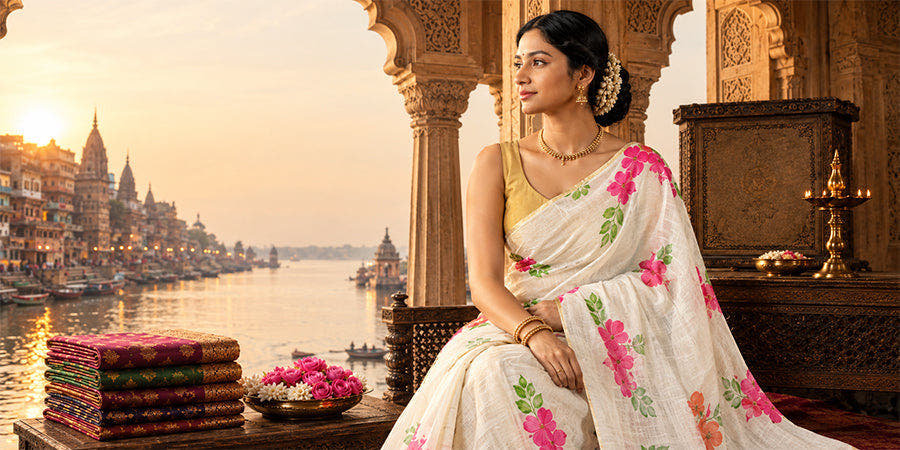
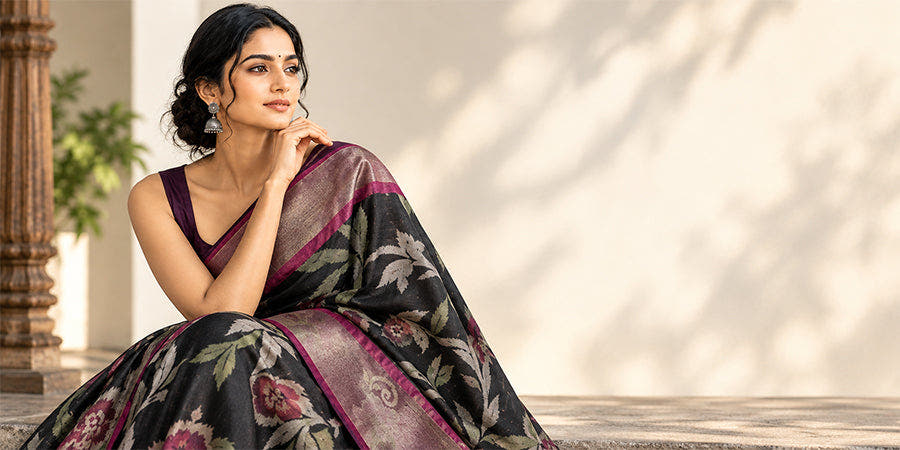
The short answer: Pochampally ikkat is the geometric weave of Telangana's Bhoodan Pochampally, made by tie-dyeing the yarns before weaving so the pattern emerges inside the cloth itself. Its signature is the softly feathered, slightly blurred edge of every motif — proof the design was dyed into the thread, not printed on the fabric.
Pattern before cloth
In most sarees, the fabric is woven first and decorated after. Ikkat reverses this: weavers calculate the design, bind sections of yarn with ties, dye them, and then weave — so warp and weft arrive at the loom already carrying the pattern. Aligning thousands of pre-dyed threads into diamonds, chevrons and rudraksha motifs is the craft's quiet miracle. Double ikkat (both warp and weft dyed) is its summit.
How to recognise a Pochampally
- Feathered edges: the tell-tale soft blur where colours meet — printed "ikkat-look" fabric has hard, crisp edges.
- Geometry first: diamonds, squares, chevrons, and the classic paan-buti — abstract rather than floral.
- Same design both sides: because the pattern lives in the yarn, the reverse mirrors the front.
Ikkat's Indian family
Pochampally shares the resist-dyed-yarn idea with Odisha's bandha (curvier, softer-lined) and Gujarat's patola (double ikkat of legendary precision). The patola-pallu style — an ikkat-patterned pallu on a silk body — has become one of today's most-loved fusion looks, and you'll find it across our Pochampally collection and silk sarees.
Where it fits in a modern wardrobe
Ikkat's clean geometry reads contemporary in a way florals don't — which is why Pochampally works equally at a festive dinner, an office celebration or an art-gallery evening. Cotton and light-silk ikkats are genuine daily-wear; richer silk ikkats with zari borders stand comfortably at weddings as a guest.
What should one cost?
Handloom double-ikkat silks command connoisseur prices. Factory-made Pochampally-style and ikkat-print sarees at Vastranand run roughly ₹999–₹1,495 factory-direct from Surat — the geometry and the look, at an everyday price. See also Gadwal borders with pochampally prints and the under-₹999 edit.
Styling notes
- Let geometry stand alone: solid blouse, minimal prints elsewhere.
- Silver and oxidised jewellery suit ikkat's modern edge better than heavy gold.
- For office festive days, a muted two-tone ikkat is the most effortless polished look in the wardrobe.
Related chapters: Gadwal Sarees Explained · How to Identify a Quality Silk Saree · The Saree Encyclopedia
Vastranand — factory-direct sarees from Surat since 2017, rated 4.9★ by 79,000+ shoppers. Cash on Delivery available across India.
Shop sarees from this story
 Soft Banarasi Patola Zari Party Wear Saree
₹ 1,695
Soft Banarasi Patola Zari Party Wear Saree
₹ 1,695 Attractive Soft Silk Gadwal Border Pochampally Print Saree
₹ 1,395
Attractive Soft Silk Gadwal Border Pochampally Print Saree
₹ 1,395 Design Soft Chanderi Silk Patola Festive Wear Saree
₹ 495
Design Soft Chanderi Silk Patola Festive Wear Saree
₹ 495 Patola Silk Saree Woven Design With Zari Border
₹ 1,545
Patola Silk Saree Woven Design With Zari Border
₹ 1,545 Attractive Soft Silk Gadwal Border Pochampally Print Saree
₹ 1,395
Attractive Soft Silk Gadwal Border Pochampally Print Saree
₹ 1,395 Soft Banarasi Patola Zari Party Wear Saree
₹ 1,695
Soft Banarasi Patola Zari Party Wear Saree
₹ 1,695 Attractive Soft Silk Gadwal Border Pochampally Print Saree
₹ 1,395
Attractive Soft Silk Gadwal Border Pochampally Print Saree
₹ 1,395 Patola Soft Silk Traditional Wear Saree
₹ 1,695
Patola Soft Silk Traditional Wear Saree
₹ 1,695 Attractive Soft Silk Gadwal Border Pochampally Print Saree
₹ 1,395
Attractive Soft Silk Gadwal Border Pochampally Print Saree
₹ 1,395 Attractive Soft Silk Gadwal Border Pochampally Print Saree
₹ 1,395
Attractive Soft Silk Gadwal Border Pochampally Print Saree
₹ 1,395Watch these sarees in motion
Loved this story? The sarees behind it are waiting for you — handcrafted, factory-direct, delivered across India.
Shop best sellers ← Back to The Vastranand Journal