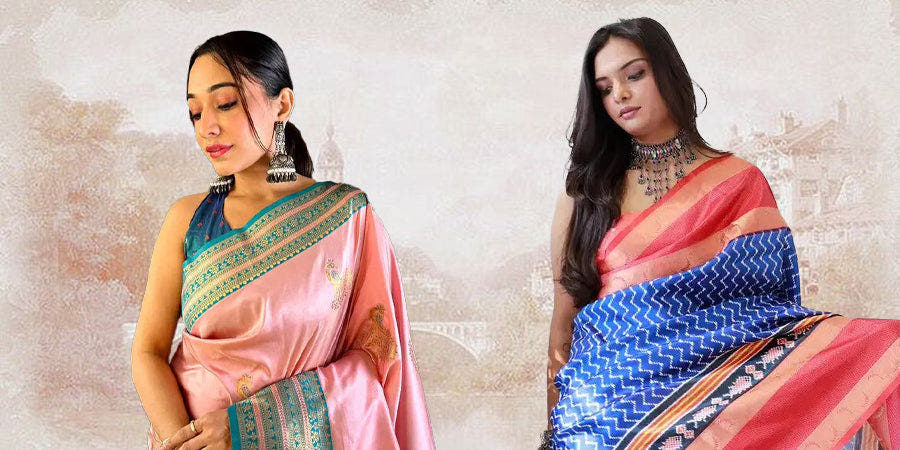
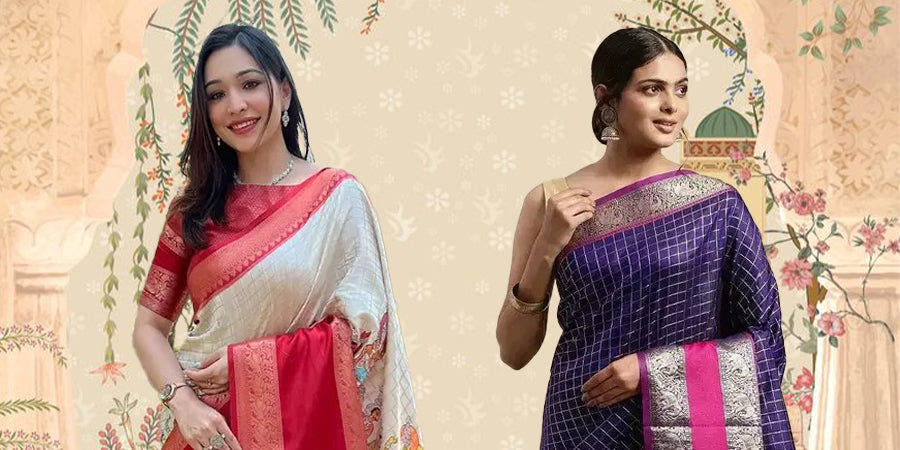
Shop Banarasi Sarees
 Soft Silk Woven Design Zari Kanchi Blend Banarasi Saree
₹ 1,250
Soft Silk Woven Design Zari Kanchi Blend Banarasi Saree
₹ 1,250 Banarasi Soft Silk Print Party Wear Saree
₹ 1,845
Banarasi Soft Silk Print Party Wear Saree
₹ 1,845 Exclusive Soft Gold Zari Tissue Digital Print Saree
₹ 1,250
Exclusive Soft Gold Zari Tissue Digital Print Saree
₹ 1,250 Exquisite Blue Pattu Banarasi Silk Saree
₹ 1,495
Exquisite Blue Pattu Banarasi Silk Saree
₹ 1,495 Eye-Catching Gadwal Soft Silk Festive Wear Saree
₹ 1,695
Eye-Catching Gadwal Soft Silk Festive Wear Saree
₹ 1,695 Banarasi Katan Silk Kalamkari Digital Print Saree
₹ 2,425
Banarasi Katan Silk Kalamkari Digital Print Saree
₹ 2,425 Light Green Soft Silk Kalamkari Digital Print Saree
₹ 1,475
Light Green Soft Silk Kalamkari Digital Print Saree
₹ 1,475 Kanjivaram Yellow Colour Soft Silk Kanchi Zari Weaving Saree
₹ 1,895
Kanjivaram Yellow Colour Soft Silk Kanchi Zari Weaving Saree
₹ 1,895 The short answer: a Banarasi saree is a silk saree woven in the tradition of Varanasi (Banaras), famous for intricate gold and silver zari brocade — florals, jaal (net) patterns and Mughal-inspired motifs woven into the fabric itself, not printed on it. It is India's most loved wedding and festive weave, and factory-direct versions start under ₹1,000.
A weave with 500 years of history
Banarasi weaving flourished under Mughal patronage from around the 16th century, when Persian motifs — trailing vines, florals, mehrab arches — met Indian silk looms. The result was brocade so rich it became the standard for royal trousseaus. To this day, a bride in much of North India is incomplete without at least one Banarasi in her wedding wardrobe.
How to recognise a Banarasi
- Woven design, both sides: flip the saree — a true woven brocade shows the pattern's threadwork on the reverse. Printed imitations look blank behind.
- Zari work: gold or silver thread forming jaal (all-over nets), butis (small motifs) or heavy pallus.
- The classic motifs: paisleys, marigolds, creepers, and border arches.
- The drape: fluid and dressy — lighter than a Kanjivaram, grander than a plain silk.
The main types you'll meet
Katan silk — pure twisted-silk body, the classic bridal base. Soft silk Banarasi — a lighter, easier-draping version that has made the weave an everyday-festive option. Chex weaving — checked zari grids, hugely popular right now (see the best-selling Cream Double Border Chex Banarasi at ₹999). Minakari — coloured enamel-style accents inside the zari. Katan-gadwal mixes like the Pista Banarasi Gadwal Pattu blend two weaving traditions.
When to wear one
Weddings (as bride, family or guest), engagements, Diwali and Karwa Chauth, receptions — anywhere you want traditional grandeur. Deep reds, maroons and greens read bridal; pastels and single-colour chex styles work for daytime functions and even dressy office celebrations.
How to style it today
- Contrast blouse to make the zari pop; every Vastranand saree includes a 0.80 m unstitched blouse piece.
- Temple or kundan jewellery for weddings, oxidised silver for a modern-festive look.
- Minimal pleating fuss: soft-silk Banarasis pleat easily even for first-time drapers.
What should a real Banarasi cost?
Pure handloom heirlooms run into tens of thousands. Factory-direct soft-silk and katan-style Banarasis — woven-design, zari-worked, quality-checked — cost ₹999–₹2,495 at Vastranand because there is no middleman between our Surat unit and your door. Browse all 890+ Banarasi sarees, the under-₹2,000 edit, or Banarasis for weddings.
Vastranand — factory-direct sarees from Surat since 2017, rated 4.9★ by 79,000+ shoppers. Cash on Delivery available across India.
Shop sarees from this story
Soft Silk Woven Design Zari Kanchi Blend Banarasi Saree
₹ 1,250
Banarasi Soft Silk Print Party Wear Saree
₹ 1,845
Exclusive Soft Gold Zari Tissue Digital Print Saree
₹ 1,250
Exquisite Blue Pattu Banarasi Silk Saree
₹ 1,495
Eye-Catching Gadwal Soft Silk Festive Wear Saree
₹ 1,695
Banarasi Katan Silk Kalamkari Digital Print Saree
₹ 2,425
Light Green Soft Silk Kalamkari Digital Print Saree
₹ 1,475
Kanjivaram Yellow Colour Soft Silk Kanchi Zari Weaving Saree
₹ 1,895 Stylish Navy Blue Colour Silk Banarasi Saree With Woven Design
₹ 1,295
Stylish Navy Blue Colour Silk Banarasi Saree With Woven Design
₹ 1,295 Grey Colour Banarasi Katan Silk Kanchi Zari Weaving Saree
₹ 1,050
Grey Colour Banarasi Katan Silk Kanchi Zari Weaving Saree
₹ 1,050Watch these sarees in motion
Loved this story? The sarees behind it are waiting for you — handcrafted, factory-direct, delivered across India.
Shop best sellers ← Back to The Vastranand Journal