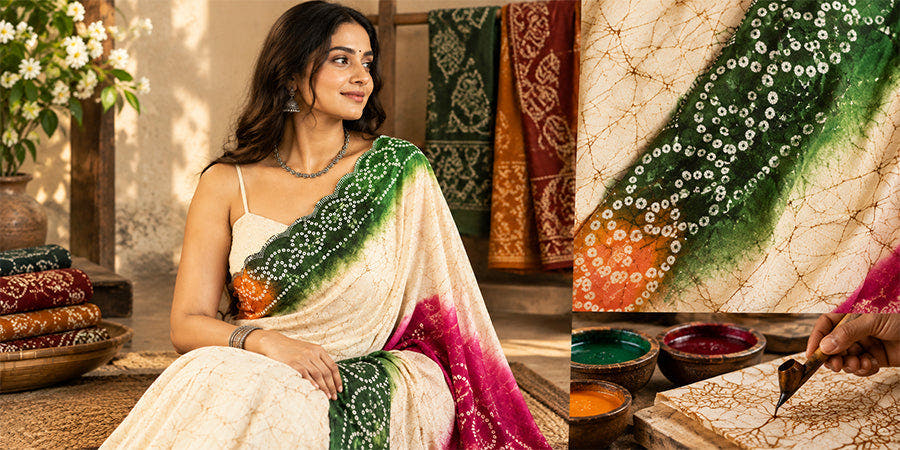
The short answer: bandhani (or bandhej) is the tie-dye craft of Gujarat and Rajasthan: thousands of tiny points of cloth are pinched, tied with thread, and dyed, so each knot resists the colour and opens into a small ring of light. A single saree can carry many thousands of hand-tied dots — the name comes from bandhan, to tie.
A craft older than memory
Bandhani's dotted cloth appears in Ajanta-era paintings, and the Khatri communities of Kutch and Saurashtra have practised it for centuries. In tradition it is auspicious cloth: the red-and-white gharchola for Gujarati brides, the leheriya turbans of Rajasthan's festivals, the panetar's sacred dots.
How the dots are born
The design is first plotted on the cloth; then tiers — often women working at home — lift each point with a fingernail or ring and bind it tight with cotton thread. The cloth is dyed light-to-dark, retied between colours for multi-tone work, and finally the threads are opened in a shower of dots. A fine 'ekdali' single-dot saree can take weeks of tying alone.
Reading bandhani's patterns
- Ekdali / Bundi: the single scattered dot — bandhani's alphabet.
- Chandrakala: dots arranged in moon-like medallions.
- Shikari: figurative rows — elephants, dancers, birds — walked across the field in dots.
- Leheriya: the diagonal wave stripes of Rajasthan, bandhani's cousin made by rolling and tying the whole cloth.
- Gharchola grid: the bridal chequerboard, each square holding its own motif.
Bandhej on today's sarees
Alongside hand-tied classics, bandhej patterns now print beautifully on modern bases — dola silk, soft silk, georgette and chiffon — which is how the festival look became an everyday possibility. Our bandhani collection runs mostly ₹750–₹1,500 factory-direct from Surat — including the pink bandhej dola silk that's been one of our best-loved sarees this year.
When and how to wear it
- Festivals first: Navratri, Teej, Karwa Chauth — bandhani IS festive dressing in the west of India.
- Colour rules: red and maroon read bridal; yellow and green read celebration; black-and-red bandhej is a modern statement.
- Style it: oxidised silver, a simple gajra, and let the dots dance (every saree ships with a 0.80 m unstitched blouse piece).
Related chapters: Ajrakh Print Sarees · What Is Kalamkari? · The Saree Encyclopedia
Vastranand — factory-direct sarees from Surat since 2017, rated 4.9★ by 79,000+ shoppers. Cash on Delivery available across India.
Shop sarees from this story
 Stylish Linen Printed Bandhani Saree with Resham Tassel
₹ 1,495
Stylish Linen Printed Bandhani Saree with Resham Tassel
₹ 1,495 Georgette Green Colour Saree With Mirror Work & Bandhani Print
₹ 595
Georgette Green Colour Saree With Mirror Work & Bandhani Print
₹ 595 Woven Printed Viscose Saree With Bandhej Motifs
₹ 1,850
Woven Printed Viscose Saree With Bandhej Motifs
₹ 1,850 Red Colour Poly Chiffon Bandhej Print & Embellished Border Saree
₹ 2,445
Red Colour Poly Chiffon Bandhej Print & Embellished Border Saree
₹ 2,445 Poly Chiffon Foil Print & Bandhej Print Red Colour Saree
₹ 2,445
Poly Chiffon Foil Print & Bandhej Print Red Colour Saree
₹ 2,445 Poly Chiffon Foil & Bandhej Print Lace Border Saree
₹ 2,445
Poly Chiffon Foil & Bandhej Print Lace Border Saree
₹ 2,445 Poly Chiffon Foil & Bandhej Print Green Colour Saree
₹ 2,445
Poly Chiffon Foil & Bandhej Print Green Colour Saree
₹ 2,445 Soft Georgette Bandhej Print Ruffle Party Wear Saree
₹ 850
Soft Georgette Bandhej Print Ruffle Party Wear Saree
₹ 850 Purple Ombre Bandhej Georgette Silk Saree
₹ 1,250
Purple Ombre Bandhej Georgette Silk Saree
₹ 1,250 Blue Ombre Bandhej Georgette Silk Saree
₹ 1,250
Blue Ombre Bandhej Georgette Silk Saree
₹ 1,250Watch these sarees in motion
Loved this story? The sarees behind it are waiting for you — handcrafted, factory-direct, delivered across India.
Shop best sellers ← Back to The Vastranand Journal