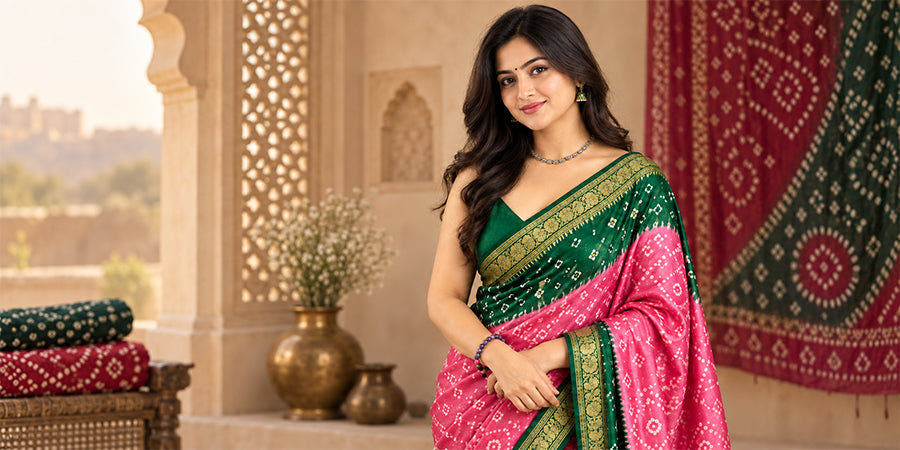
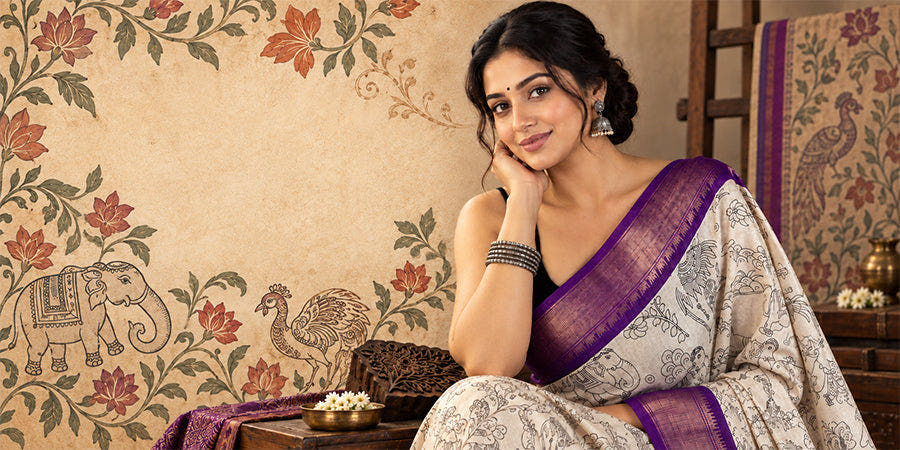
The short answer: ajrakh is the resist block-printing tradition of Kutch and Sindh — deep indigo and madder red laid down in mirror-symmetric geometry through as many as sixteen stages of washing, resisting, printing and dyeing. Its patterns echo motifs found in the Indus Valley civilisation, making ajrakh one of the world's oldest living print traditions.
A cloth of the desert
Ajrakh belongs to the Khatri printer families of Kutch (Gujarat) and Sindh, who have carried the craft for generations — traditionally worn as turbans and shoulder cloths by desert herders, its indigo cooling under sun. The name is often traced to "azrak", blue — the colour at the craft's heart.
Sixteen steps of patience
Real ajrakh is printed on both sides of the cloth in registration — a feat of precision. The cloth cycles through washing, treatment with myrobalan, lime-and-gum resist printing, iron-black outlines, alum mordanting, indigo vats, madder boils and river washes; each colour arrives through chemistry, not brushwork. The signature palette — indigo blue, madder red, black, and the white of the resisted cloth — comes entirely from this layered dyeing.
Reading ajrakh's geometry
- Central jaal: a repeating star-and-lattice field with the mesmerising symmetry of Islamic tilework.
- Borders within borders: ajrakh compositions frame the field the way a carpet does.
- Mirror logic: fold a true ajrakh along its centre and the halves answer each other.
Ajrakh on the saree
Sarees are ajrakh's modern stage: the geometry runs magnificently along six metres. Today you'll find hand-block ajrakh on cottons and modals at connoisseur prices — and ajrakh-inspired prints on georgette, dola silk and modal bases that bring the desert's palette to festive and daily wear at accessible prices. Browse ajrakh sarees — most ₹999–₹1,550 factory-direct from Surat — including our best-selling mirror-work ajrakh styles.
Styling the indigo classic
- Silver is ajrakh's soulmate — oxidised jhumkas or a kada complete the Kutchi look.
- Keep the blouse in indigo, madder or black picked from the print (0.80 m unstitched piece included).
- Ajrakh reads intellectual-elegant: it belongs equally at an exhibition opening and a festive dinner.
Related chapters: What Is Kalamkari? · Pochampally Ikkat · The Saree Encyclopedia
Vastranand — factory-direct sarees from Surat since 2017, rated 4.9★ by 79,000+ shoppers. Cash on Delivery available across India.
Shop sarees from this story
 Soft Linen Kalamkari Block Print Party Wear Saree
₹ 1,745
Soft Linen Kalamkari Block Print Party Wear Saree
₹ 1,745 Soft Linen Leheriya Print &Sequence Work Saree
₹ 1,745
Soft Linen Leheriya Print &Sequence Work Saree
₹ 1,745 Soft Linen Kalamkari Block Print Party Wear Saree
₹ 599
Soft Linen Kalamkari Block Print Party Wear Saree
₹ 599 Soft Linen Mughal Print & Sequence Work Saree
₹ 1,745
Soft Linen Mughal Print & Sequence Work Saree
₹ 1,745 Soft Linen Kalamkari Block Print Party Wear Saree
₹ 599
Soft Linen Kalamkari Block Print Party Wear Saree
₹ 599 Black Linen Ajrakh Print Saree
₹ 999
Black Linen Ajrakh Print Saree
₹ 999 Red Ikkat Ajrakh Print Viscose Saree
₹ 1,250
Red Ikkat Ajrakh Print Viscose Saree
₹ 1,250 Chocolate Brown Ajrakh Print Viscose Saree
₹ 1,850
Chocolate Brown Ajrakh Print Viscose Saree
₹ 1,850 Ink Blue Ajrakh Print Viscose Saree
₹ 1,850
Ink Blue Ajrakh Print Viscose Saree
₹ 1,850 Royal Purple Ajrakh Print Viscose Saree
₹ 1,850
Royal Purple Ajrakh Print Viscose Saree
₹ 1,850Watch these sarees in motion
Loved this story? The sarees behind it are waiting for you — handcrafted, factory-direct, delivered across India.
Shop best sellers ← Back to The Vastranand Journal