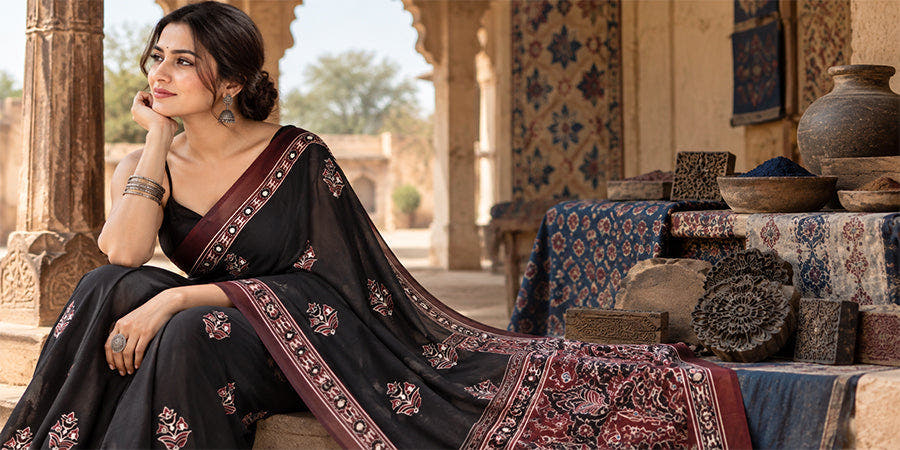
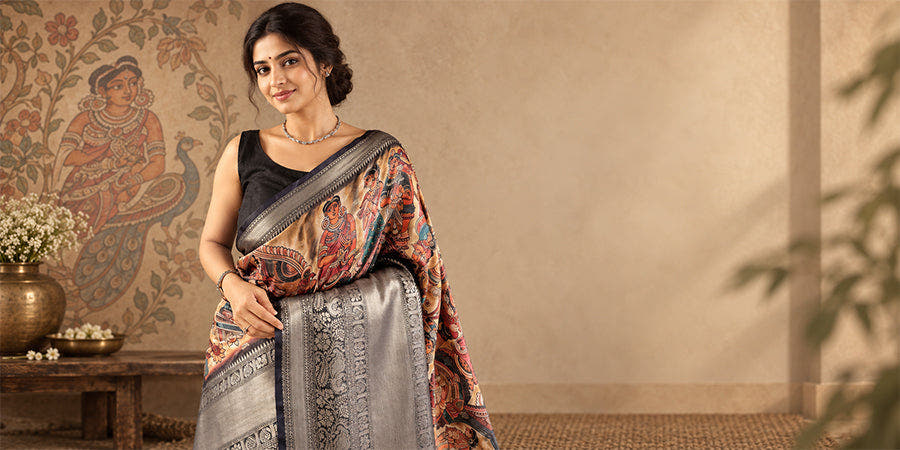
The short answer: kalamkari — literally "pen-work" (kalam = pen, kari = craft) — is the ancient Indian art of drawing and dyeing stories onto fabric: mythological scenes, temple florals, birds and vines, traditionally rendered in earthy natural dyes. Born in Andhra Pradesh some 3,000 years ago, it survives today both as painstaking hand-craft and as beloved prints on sarees.
Two schools, one art
Srikalahasti style is the freehand school: artists draw directly with a bamboo pen dipped in fermented jaggery-iron ink, then fill colours dye by dye — the temple-storytelling tradition, full of scenes from the Ramayana and Mahabharata. Machilipatnam style is the block school: intricate carved blocks print the outlines, with brush-filled colour — the version Persian and Mughal traders carried across the world as prized "chintz".
Why it takes twenty-odd steps
True hand kalamkari is a slow chemistry: cloth treated in myrobalan and milk so dyes hold; the kalam outline; alum mordants; dips in madder for reds; indigo for blues; sun-bleaching between stages. There are up to 23 steps between plain cloth and finished piece — the reason genuine hand kalamkari commands collector prices, and the reason printed kalamkari exists.
Reading the motifs
- Mythological panels: gods, chariots and epics — the signature of Srikalahasti work.
- The tree of life: a flowering, bird-filled tree — the classic Machilipatnam centrepiece.
- Pichwai companions: lotus ponds, cows and Krishna imagery, cousins from the temple-art family, now beloved on saree pallus.
- Earth palette: madder red, iron black, indigo, mustard, cream — if the colours whisper rather than shout, it's speaking kalamkari's language.
Kalamkari on today's sarees
The craft's second life is print: kalamkari's vocabulary reproduced on modern bases — dola silk, soft silk, mul cotton and kota — giving the heritage look at everyday weight and price. It's how a 3,000-year-old art ends up at the office, at festivals, and in young wardrobes. Browse 970+ kalamkari sarees, mostly ₹750–₹1,500 factory-direct from Surat.
Styling the storyteller
- Let the art lead: solid blouse in one of the saree's dye tones (a 0.80 m unstitched blouse piece comes with every saree).
- Oxidised silver, terracotta or wooden jewellery suit the earthy palette beautifully.
- For work wear, a kalamkari-print cotton or dola is the most effortlessly cultured saree in the room.
Related chapters: Pochampally Ikkat · Fabric for Every Season · The Saree Encyclopedia
Vastranand — factory-direct sarees from Surat since 2017, rated 4.9★ by 79,000+ shoppers. Cash on Delivery available across India.
Shop sarees from this story
 Designer Kalamkari Print Pattu Banarasi Silk Saree
₹ 1,495
Designer Kalamkari Print Pattu Banarasi Silk Saree
₹ 1,495 Exquisite Red Colour Kalamkari Pattu Banarasi Silk Saree
₹ 1,495
Exquisite Red Colour Kalamkari Pattu Banarasi Silk Saree
₹ 1,495 Lavender Colour Satin Kota Doria Digital Kalamkari Zari Pallu
₹ 1,495
Lavender Colour Satin Kota Doria Digital Kalamkari Zari Pallu
₹ 1,495 Pink Colour Show Stopper Soft Silk Kalamkari Saree
₹ 1,250
Pink Colour Show Stopper Soft Silk Kalamkari Saree
₹ 1,250 Silver Colour Satin Kota Doria Digital Kalamkari Zari Pallu
₹ 1,495
Silver Colour Satin Kota Doria Digital Kalamkari Zari Pallu
₹ 1,495 Blue Colour Geometric Print Saree With kalamkari Print Design
₹ 1,250
Blue Colour Geometric Print Saree With kalamkari Print Design
₹ 1,250 Maroon Colour Double Border Chex Weaving Banarasi Soft Silk Saree
₹ 999
Maroon Colour Double Border Chex Weaving Banarasi Soft Silk Saree
₹ 999 Grey Colour Satin Kota Doria Digital Kalamkari Zari Pallu
₹ 1,495
Grey Colour Satin Kota Doria Digital Kalamkari Zari Pallu
₹ 1,495 Purple Colour Satin Kota Doria Digital Kalamkari Zari Pallu
₹ 1,495
Purple Colour Satin Kota Doria Digital Kalamkari Zari Pallu
₹ 1,495 Green Colour Block Print Saree With kalamkari Print Pallu
₹ 1,250
Green Colour Block Print Saree With kalamkari Print Pallu
₹ 1,250Watch these sarees in motion
Loved this story? The sarees behind it are waiting for you — handcrafted, factory-direct, delivered across India.
Shop best sellers ← Back to The Vastranand Journal