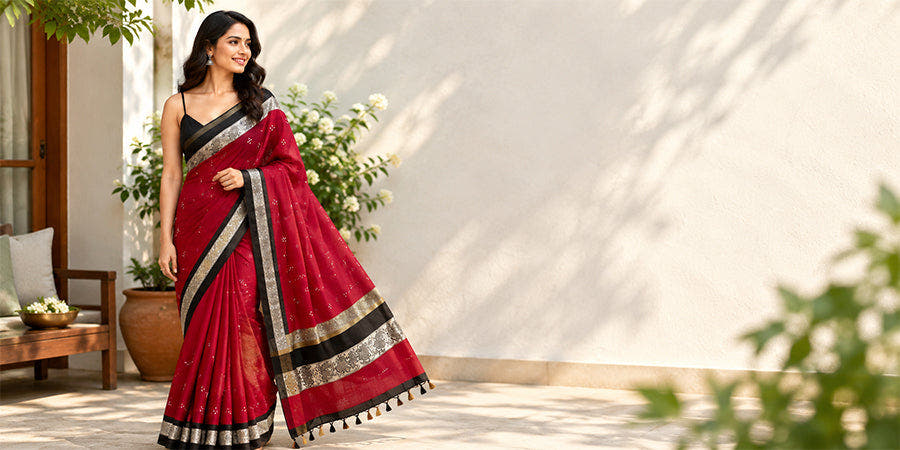
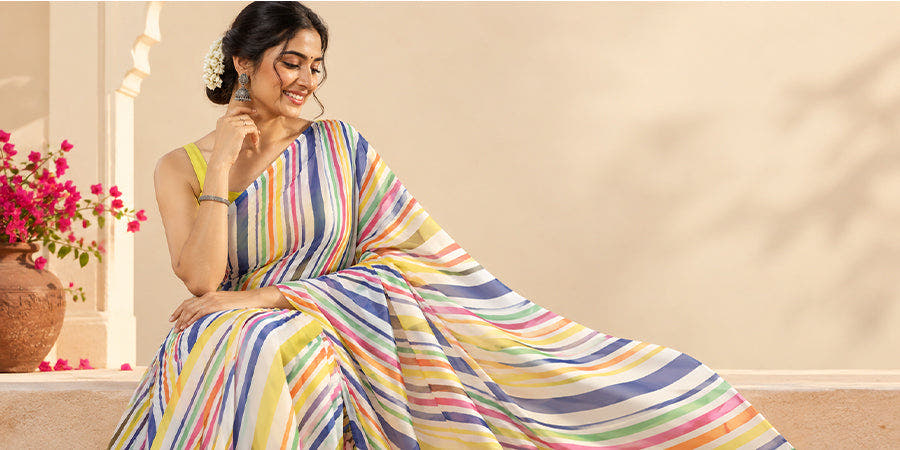
The short answer: tussar (or tasar) is India's wild silk — spun by silkworms that live free on forest trees rather than farmed mulberry. That wild origin gives tussar everything mulberry silk isn't: a natural deep-gold tone, a dry textured hand, feather weight and breathability. It is the year's fastest-rising weave for a reason.
Silk of the forest belt
Tussar's homeland is the tribal forest belt of eastern India — Jharkhand, Chhattisgarh, Odisha, West Bengal — where cocoons are gathered from asan and arjun trees. India is the world's second-largest tussar producer, and for forest communities the silk is a centuries-old livelihood. Bhagalpur in Bihar earned the name "silk city" weaving it.
Why tussar feels different
- The texture: tussar yarn is naturally uneven, giving the fabric its beloved slubs and a matt, organic character — nothing like mulberry's glass-smooth shine.
- The colour: undyed tussar is honey-gold; dyes over it turn muted and earthy, which is why tussar palettes feel so sophisticated.
- The weight: among the lightest silks — cool, airy, genuinely wearable through an Indian day.
- The drape: crisp rather than clingy; tussar holds a sculptural, art-gallery silhouette.
What tussar wears best
Tussar is the natural canvas for craft: block prints, kalamkari panels, ghicha borders, ikkat weaves and hand-painted pallus all sit beautifully on its textured gold ground. Explore 700+ tussar sarees — most ₹999–₹1,500 factory-direct from Surat — from office-ready solids to festive zari chex styles.
When to wear it
- Work and daytime events: tussar's matt elegance is the most workplace-perfect silk there is.
- Festive daylight: pujas, daytime ceremonies, gallery openings — occasions where glow beats glitter.
- Season: comfortable most of the year; its breathability makes it the silk that summer allows.
Caring for wild silk
Dry-clean or gentle cold hand-wash, dry in shade, medium iron on the reverse, store breathing in muslin. Tussar softens gorgeously with age — a good one becomes more itself every year.
Spotting good tussar
Look for visible natural slubs (too uniform = imitation), the dry papery rustle, and honest fabric naming. Our guide covers the full checklist: How to Identify a Quality Silk Saree. Start with the tussar under ₹1,500 edit or the wider silk collection.
Related chapters: Soft Silk vs Pure Silk · The Saree Encyclopedia
Vastranand — factory-direct sarees from Surat since 2017, rated 4.9★ by 79,000+ shoppers. Cash on Delivery available across India.
Shop sarees from this story
 Pink Bandhej Printed Dola Silk Saree
₹ 750
Pink Bandhej Printed Dola Silk Saree
₹ 750
 Multi Satin Georgette Saree
₹ 1,050
Multi Satin Georgette Saree
₹ 1,050 Cream Colour Double Border Chex Weaving Banarasi Soft Silk Saree
₹ 999
Cream Colour Double Border Chex Weaving Banarasi Soft Silk Saree
₹ 999 White Soft Silk Pashmina Kashmiri Print Saree
₹ 999
White Soft Silk Pashmina Kashmiri Print Saree
₹ 999 Sky Blue Satin Georgette Saree
₹ 1,050
Sky Blue Satin Georgette Saree
₹ 1,050 Vibrant Soft Chinnon Chiffon Floral Saree
₹ 750
Vibrant Soft Chinnon Chiffon Floral Saree
₹ 750 Soft Silk Pashmina Kashmiri Print Saree
₹ 999
Soft Silk Pashmina Kashmiri Print Saree
₹ 999 Sky Blue Pochampally Patola Soft Silk Saree
₹ 1,050
Sky Blue Pochampally Patola Soft Silk Saree
₹ 1,050 Classic Floral Print Chiffon Saree
₹ 1,050
Classic Floral Print Chiffon Saree
₹ 1,050
 Cream Soft Silk Kanjivaram Saree
₹ 1,450
Cream Soft Silk Kanjivaram Saree
₹ 1,450Watch these sarees in motion
Loved this story? The sarees behind it are waiting for you — handcrafted, factory-direct, delivered across India.
Shop best sellers ← Back to The Vastranand Journal